

Budget Ngorongoro Crater Safari Holiday
Planning a budget Ngorongoro Crater safari holiday from Arusha? Compare a crater day trip, a two-day Tarangire and Ngorongoro safari, or a…
Read articleArusha City - Tanzania
Safari & Travel Tips
August 27, 2026 · 16 min read
A Ngorongoro Tanzania safari takes you into one of Africa’s most extraordinary wildlife landscapes. Located along Tanzania’s famous Northern Safari Circuit, the Ngorongoro Conservation Area combines dramatic volcanic scenery, exceptional concentrations of wildlife, Maasai culture, archaeological sites, and convenient connections to Serengeti National Park, Tarangire National Park, and Lake Manyara.
At the center of the experience is the spectacular Ngorongoro Crater, the world’s largest unbroken volcanic caldera. UNESCO recognizes the wider Ngorongoro Conservation Area as a World Heritage Site because of its remarkable landscapes, biodiversity, archaeological importance, and long relationship between people and wildlife.
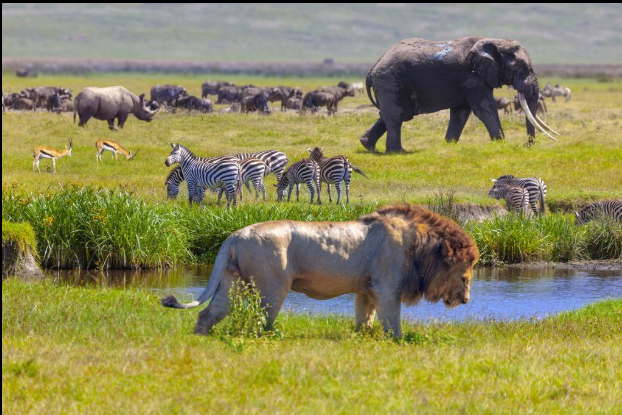
For travelers hoping to see lions, elephants, buffalo, zebras, wildebeest, hippos, hyenas, and the endangered black rhinoceros within a relatively compact area, Ngorongoro is one of the most rewarding places to include in a Tanzania safari itinerary.
Ngorongoro offers something different from almost every other safari destination in Tanzania. Instead of spending hours searching across an enormous national park, visitors descend from the highlands into a vast natural basin where wildlife is concentrated across grasslands, wetlands, forest, and lake habitats.
The crater is especially attractive to first-time safari travelers because a single game drive can produce an impressive variety of sightings.
A typical day may include:
UNESCO notes that the Ngorongoro Conservation Area supports an exceptionally high concentration of wildlife and is internationally important for species such as the black rhinoceros.
The combination of wildlife density and spectacular scenery is what makes a Ngorongoro safari in Tanzania so memorable.
The Ngorongoro Conservation Area is located in northern Tanzania between the Serengeti ecosystem and the Great Rift Valley.
Most safaris approach Ngorongoro from Arusha, Tanzania’s main safari hub.
The route normally follows:
Arusha → Lake Manyara/Mto wa Mbu → Karatu → Ngorongoro Conservation Area
Karatu is one of the most popular overnight bases because it offers accommodation ranging from affordable lodges to stylish luxury properties.
The main entrance is Loduare Gate, approximately 14 km from Karatu. Other access points connect Ngorongoro with Serengeti and surrounding areas.
Ngorongoro therefore fits naturally into itineraries combining several northern Tanzanian parks.
Travelers sometimes use "Ngorongoro" and "Ngorongoro Crater" interchangeably, but they refer to different areas.
The Ngorongoro Conservation Area is the much larger protected landscape.
It covers approximately 809,440 hectares and contains highland grasslands, forests, savanna, volcanic formations, archaeological sites, wildlife corridors, and several craters.
The Ngorongoro Crater is one spectacular feature inside that conservation area.
Other attractions include:
One of the world's most important paleoanthropological locations. Research in this region has contributed enormously to understanding early human evolution.
A quieter crater in the northern highlands, famous for dramatic scenery and hiking opportunities.
Another volcanic formation offering scenic walking experiences.
These plains become particularly important during the Great Migration calving season.
More remote landscapes suited to travelers interested in scenery, hiking, and areas beyond conventional safari routes. NCAA lists activities in this region including game drives and hiking.
For most first-time visitors, however, a Ngorongoro Crater game drive remains the main attraction.
Imagine waking before sunrise in Tanzania’s cool highlands.
Your safari vehicle drives toward the crater rim while low clouds drift across the forest. Then suddenly the landscape opens.
Far below lies an enormous natural amphitheater filled with grasslands, water, woodland, and wildlife.
The Ngorongoro Crater is considered the world's largest unbroken caldera.
After reaching the descent road, your 4x4 begins traveling down toward the crater floor.
Temperatures gradually become warmer.
Zebras appear.
Then wildebeest.
Buffalo.
Perhaps hyenas crossing the track.
And sometimes, within minutes of reaching the plains, your guide spots lions.
That concentration of wildlife is what makes Ngorongoro different from destinations where animals are dispersed across thousands of square kilometers.
Ngorongoro is particularly famous for large mammals.
Lions are among the most commonly sought predators in the crater. Because prey is abundant, visitors have excellent opportunities to observe lion behavior.
You might see:
Early morning is particularly rewarding because predators are often more active.
The endangered black rhino is one of Ngorongoro's most celebrated animals.
Sightings cannot be guaranteed, but the crater remains one of Tanzania's important locations for travelers hoping to see rhinos in the wild.
Bring binoculars because rhinos are sometimes spotted at considerable distance.
Elephants are regularly seen, particularly mature bulls.
The crater's Lerai Forest is an especially attractive habitat for elephants.
Buffalo occur throughout the crater and may be seen individually or in substantial herds.
Large numbers of wildebeest inhabit the crater and surrounding conservation area.
The wider Ngorongoro landscape also plays an important role in the Serengeti ecosystem's annual migration. UNESCO highlights the movement of wildebeest, zebra, and gazelles across the property.
Zebras are extremely common and often share grazing areas with wildebeest.
Hippo pools provide excellent opportunities for photography and relaxed wildlife viewing.
Spotted hyenas are among the crater's most important predators and scavengers.
Visitors frequently see them:
Leopards occur in the conservation area but are generally harder to see on the open crater floor.
Travelers spending additional time around Serengeti often have better opportunities for leopard sightings.
Ngorongoro is frequently associated with Big Five safari experiences.
The Big Five are:
Lions, elephants, buffalo, and black rhinos may all be encountered around Ngorongoro.
Leopards can also occur in the wider ecosystem, although sightings during a single crater game drive are much less predictable.
No ethical safari operator should guarantee all five species.
Wildlife remains wild, and sightings depend on animal movements, weather, vegetation, timing, and luck.
One major advantage of Ngorongoro is that wildlife viewing is possible throughout the year.
There is no single month that works for every traveler.
Your ideal travel period depends on whether you prioritize wildlife visibility, green scenery, photography, migration activity, lower visitor numbers, or weather.
The dry season is one of the most popular periods for a Tanzania safari.
Expect:
July, August, and September are particularly popular months.
If traveling during peak season, booking early is advisable.
Short rains begin transforming the landscape.
Vegetation becomes greener and photography can be beautiful.
Rainfall often comes in showers rather than continuous all-day rain.
This is a fascinating time to combine Ngorongoro with Ndutu and southern Serengeti.
Large numbers of wildebeest gather across the short-grass plains during the wider migration cycle, with calving activity normally concentrated around January and February.
Travelers interested in predators, newborn animals, and wildlife photography often choose this period.
April and May are generally wetter.
Advantages may include:
Road conditions can be wetter and more challenging, but a capable 4x4 safari vehicle is designed for this environment.
Conditions can change dramatically between the rim and crater floor.
The crater rim sits at high elevation, making mornings and evenings surprisingly cold.
Pack layers.
Useful clothing includes:
Once you descend into the crater, temperatures are usually warmer.
Layered clothing lets you adjust throughout the day.
A well-planned crater safari normally begins early.
If you stay around Karatu, your guide may collect you in the morning and drive toward Loduare Gate.
Travelers staying on or near the crater rim have an even shorter morning journey.
After formalities, you continue toward the descent road.
NCAA states that gates to the wider conservation area operate from 06:00 to 18:00, while crater gates are listed as open from 06:00 to 16:00.
Descend into the crater and begin searching for predators while animals are active.
Your guide may concentrate on open grassland first.
Explore different habitats looking for buffalo, elephants, zebras, wildebeest, hyenas, rhinos, and birds.
Most safaris include a packed or hot lunch depending on the tour arrangement.
A common picnic area allows visitors to take a break before continuing the drive.
Continue wildlife viewing before climbing out of the crater.
Depending on the itinerary, you may then drive toward:
Because Ngorongoro sits between several major destinations, it works extremely well within multi-day safari routes.
Arusha is the usual starting point.
Driving from Arusha toward the Ngorongoro highlands generally takes several hours depending on traffic, stops, road conditions, and your accommodation.
Although a same-day excursion is technically possible, it creates a long day.
For better comfort, many itineraries include an overnight stay in Karatu or near the conservation area.
A typical short itinerary might look like:
Day 1: Arusha → Tarangire → Karatu
Day 2: Ngorongoro Crater game drive → Arusha
This provides a much more relaxed experience than driving all the way from Arusha, completing the crater game drive, and returning in one day.
One of Tanzania's classic itineraries combines Serengeti National Park and Ngorongoro Crater.
These destinations complement each other perfectly.
Serengeti provides:
Ngorongoro provides:
A popular route is:
Arusha → Tarangire → Serengeti → Ngorongoro → Arusha
For travelers with limited time:
Arusha → Serengeti → Ngorongoro → Arusha
can also work.
A three-day safari works well for visitors with limited time.
Leave Arusha in the morning.
Spend the day exploring Tarangire National Park, famous for elephants and baobab-dominated landscapes.
Stay around Karatu or near Lake Manyara.
Depending on your preferred route, travel toward Serengeti or enjoy another northern-circuit destination.
Depart early and descend into Ngorongoro Crater.
Enjoy several hours of wildlife viewing before returning toward Arusha.
For travelers prioritizing Serengeti, a three-day Serengeti and Ngorongoro safari can be arranged instead.
Four days provide significantly better pacing.
A classic itinerary is:
Day 1: Arusha → Tarangire
Day 2: Tarangire/Karatu → Serengeti
Day 3: Serengeti → Ngorongoro highlands
Day 4: Ngorongoro Crater → Arusha
This route gives visitors three distinct safari environments without making the trip excessively long.
Five days is an excellent length for a first Tanzania safari.
A popular itinerary includes:
Day 1 – Tarangire National Park
Elephants, baobabs, giraffes, zebras, and predators.
Day 2 – Serengeti National Park
Drive through the Ngorongoro Conservation Area toward Serengeti.
Day 3 – Full-Day Serengeti Safari
Spend an entire day exploring the plains.
Day 4 – Serengeti to Ngorongoro
Morning wildlife viewing followed by the journey toward Ngorongoro.
Day 5 – Ngorongoro Crater
Early descent, crater game drive, lunch, and return to Arusha.
Five days offers a much richer safari than rushing through each park.
Both formats can work well.
A private safari gives you a dedicated 4x4 vehicle and guide.
Advantages include:
Private safaris are generally more expensive per person, particularly for solo travelers or couples.
However, the cost per person normally decreases as more travelers share the private vehicle.
Joining a shared safari can reduce costs considerably.
You travel with other guests in the same safari vehicle.
Group safaris are suitable for:
The trade-off is reduced flexibility because the itinerary must work for everyone in the group.
Accommodation plays an important role in both comfort and safari price.
Budget safaris may use simple lodges, guesthouses, or camping.
These options are appropriate for travelers who prioritize wildlife experiences over luxury facilities.
Mid-range is one of the most popular categories.
You can generally expect:
Properties around Karatu often provide particularly good value.
Luxury properties may offer:
Staying near the crater rim can shorten the morning drive before your descent, while Karatu often gives travelers more accommodation choices.
Camping is a popular way to reduce the cost of a Tanzania safari.
A typical camping safari may include:
Ngorongoro nights can become cold because of the altitude.
Pack warm clothes even when Tanzania feels hot during the daytime.
Camping is especially popular with adventurous travelers combining Tarangire, Serengeti, and Ngorongoro.
There is no universal price.
Your final cost depends on:
Ngorongoro can be more expensive than some other destinations because visiting the crater involves conservation and vehicle-related charges.
Official tariffs can change, so travelers should verify the current amount at the time of booking. The Ngorongoro Conservation Area Authority provides official information about entrance, vehicle, crater, and other fees on its website.
When comparing safari quotations, do not judge them only by the headline price.
Check exactly what is included.
A properly structured safari package will commonly include:
Some operators also include:
Always read the inclusions and exclusions carefully before making payment.
A 4x4 Land Cruiser is the standard vehicle for most Tanzania safaris.
Important features may include:
The pop-up roof makes it possible to stand safely while photographing wildlife.
A private Land Cruiser is particularly valuable for photographers because vehicle positioning and the length of time spent at sightings can be more flexible.
Ngorongoro is outstanding for photography.
The crater walls create one of East Africa's most recognizable safari backgrounds.
Good subjects include:
Bring:
Dust can be significant during dry months, so protect camera equipment when the vehicle is moving.
Ngorongoro can be excellent for families.
Because wildlife is concentrated, children may not need to wait as long between major sightings.
Private safaris work particularly well because parents can control:
For younger children, consider shortening long transfer days between Ngorongoro and Serengeti.
For honeymooners, Ngorongoro combines exceptionally well with:
A popular honeymoon itinerary might involve:
Arusha → Tarangire → Serengeti → Ngorongoro → Zanzibar
Choose private transport and comfortable lodges if privacy is important.
Luxury accommodations around the highlands can also provide romantic dinners, beautiful views, and special honeymoon arrangements.
Combining safari with Zanzibar is one of Tanzania's most popular holiday formats.
Start with wildlife on the mainland, then fly to Zanzibar for beaches and relaxation.
For example:
Days 1–5: Tarangire, Serengeti and Ngorongoro
Days 6–10: Zanzibar
This combination offers:
Domestic flights can significantly reduce travel time between northern Tanzania and Zanzibar.
The Great Migration is normally associated with Serengeti, but parts of the wider Ngorongoro Conservation Area play an essential role in the migration cycle.
UNESCO specifically notes the movement of large numbers of wildebeest, zebra, and gazelles through the conservation area.
The Ndutu region, spanning the southern Serengeti–Ngorongoro ecosystem, becomes particularly important during the green season.
From approximately December through March, travelers may see enormous concentrations of grazing animals.
January and February are especially associated with calving.
This attracts predators such as:
Travelers visiting primarily for the migration should therefore choose their accommodation and safari route according to the season rather than assuming the animals remain in Central Serengeti throughout the year.
Ngorongoro is unusual because it is a conservation area rather than simply a conventional national park.
Maasai pastoral communities have historically shared this broader landscape with wildlife.
UNESCO describes Ngorongoro as a multiple-land-use area where wildlife has coexisted with semi-nomadic Maasai pastoralists.
Cultural visits can be incorporated into some itineraries.
Responsible experiences should be approached respectfully rather than treating communities as tourist displays.
Ask your safari operator how the visit is organized and how local communities benefit.
Travelers driving between Ngorongoro and Serengeti can consider visiting Olduvai Gorge, also commonly spelled Oldupai.
The gorge is internationally important because of discoveries related to human evolution.
UNESCO recognizes the wider area's exceptional archaeological record, which extends across millions of years.
It is particularly worthwhile for travelers interested in:
Adding it to a Serengeti–Ngorongoro route is often easier than arranging it separately.
Travelers seeking something beyond conventional game drives can consider Empakaai.
The area offers dramatic views and guided walking opportunities.
It is quieter and wilder than the main Ngorongoro Crater.
A hiking-focused itinerary may combine:
This is especially attractive to active travelers who want both safari and walking experiences.
Pack light but prepare for changing temperatures.
Recommended items include:
Neutral colors such as khaki, tan, beige, and olive are practical.
Avoid packing only shorts and T-shirts because early mornings on the Ngorongoro rim can be cold.
Ngorongoro is both ecologically sensitive and culturally important.
UNESCO has highlighted tourism pressure as one of the issues requiring careful management within the conservation area.
Visitors can help by:
Wildlife should never be pressured merely to obtain a better photograph.
The quality of your guide and itinerary can dramatically affect your experience.
Before booking, ask:
Choose an established Tanzania safari operator.
Confirm whether you will have a 4x4 Land Cruiser and whether your safari is private or shared.
Request a clear list of inclusions.
Ask for exact property names rather than accepting descriptions such as "luxury lodge" without details.
Confirm both arrival and departure arrangements.
A good safari company should explain equivalent alternatives.
Read deposit and refund terms before paying.
Private tours should usually allow significantly more flexibility.
Ngorongoro is exceptional, but combining it with other destinations creates a more complete safari.
Best for big cats, migration opportunities, and classic African plains.
Excellent for elephants, baobabs, and contrasting landscapes.
Useful for shorter itineraries and Rift Valley scenery.
Excellent during the calving season.
Ideal for travelers wanting safari plus beach.
A Ngorongoro Tanzania safari can be anything from a short two-day wildlife trip to part of a longer luxury journey combining Tarangire, Serengeti, Ngorongoro, Ndutu, and Zanzibar.
For the strongest experience, build the itinerary around your travel month, budget, accommodation preference, and wildlife priorities rather than simply choosing the cheapest package.
A well-planned Ngorongoro safari can include:
Whether you are planning your first African safari, a honeymoon, a family holiday, a photography journey, or a private wildlife adventure, Ngorongoro deserves a place near the top of your Tanzania itinerary.
From the moment your vehicle reaches the crater rim and the enormous caldera appears below, it becomes clear why this landscape has earned worldwide recognition.
For travelers seeking wildlife, scenery, culture, and one of Tanzania's most iconic safari experiences in a single destination, Ngorongoro is difficult to surpass.
Planning a budget Ngorongoro Crater safari holiday from Arusha? Compare a crater day trip, a two-day Tarangire and Ngorongoro safari, or a…
Read articleA Lake Manyara safari can cost USD 150–220 per person for a shared day trip from Arusha. A published example of a…
Read articleA Tanzania safari from Zanzibar can mean a short mainland trip during your beach holiday or a complete package with flights, game…
Read articleLooking for a group Tanzania safari price from Kilipath African Safaris? A published example for our four-day shared camping safari through Tarangire,…
Read article

