

Budget Ngorongoro Crater Safari Holiday
Planning a budget Ngorongoro Crater safari holiday from Arusha? Compare a crater day trip, a two-day Tarangire and Ngorongoro safari, or a…
Read articleArusha City - Tanzania
Safari & Travel Tips
August 31, 2026 · 16 min read
A journey combining Serengeti National Park and Ruaha National Park introduces travelers to two remarkably different sides of Tanzania. The Serengeti offers legendary plains, abundant predators and the Great Wildebeest Migration, while Ruaha delivers remote landscapes, ancient baobab trees, enormous elephant herds and quiet game-viewing areas.
However, these parks are located in different regions of Tanzania. The Serengeti is part of the country’s Northern Safari Circuit, whereas Ruaha lies in south-central Tanzania. Combining them successfully requires thoughtful planning, suitable domestic flights and the assistance of an experienced Serengeti safari Ruaha company.
This complete guide explains how to connect the two parks, when to travel, what animals you may encounter, how many days you need and what to consider when choosing a safari operator.
Many first-time visitors concentrate on Tanzania’s Northern Circuit because it contains Serengeti National Park, Ngorongoro Crater, Tarangire National Park and Lake Manyara. These destinations are famous for their wildlife density and relatively convenient road connections.
Ruaha National Park offers an entirely different atmosphere. It is more remote, receives fewer visitors and presents a dramatic mixture of open plains, rocky hills, seasonal rivers and baobab woodland.
Combining Serengeti and Ruaha allows you to experience:
According to Tanzania National Parks, Ruaha covers approximately 20,226 square kilometres and is Tanzania’s second-largest national park. Its remote location creates a quieter safari experience than Tanzania’s more heavily visited parks. Tanzania National Parks—Ruaha
A combined safari is especially suitable for repeat African travelers, photographers, honeymooners and wildlife enthusiasts who want more than a standard Northern Circuit itinerary.
Serengeti National Park is Tanzania’s most internationally recognized wildlife destination. Its name comes from a Maasai expression commonly translated as “endless plains,” an appropriate description of the park’s expansive grasslands.
The Serengeti ecosystem extends beyond the national park itself and includes neighboring conservation areas and reserves. Animals move throughout this ecosystem according to water availability and seasonal rainfall.
The Serengeti supports an extraordinary variety of wildlife. Depending on your route, season and luck, you may encounter:
Central Serengeti, particularly the Seronera region, is known for dependable year-round wildlife viewing. Permanent water sources attract resident animals even when the migrating herds have moved into another part of the ecosystem.
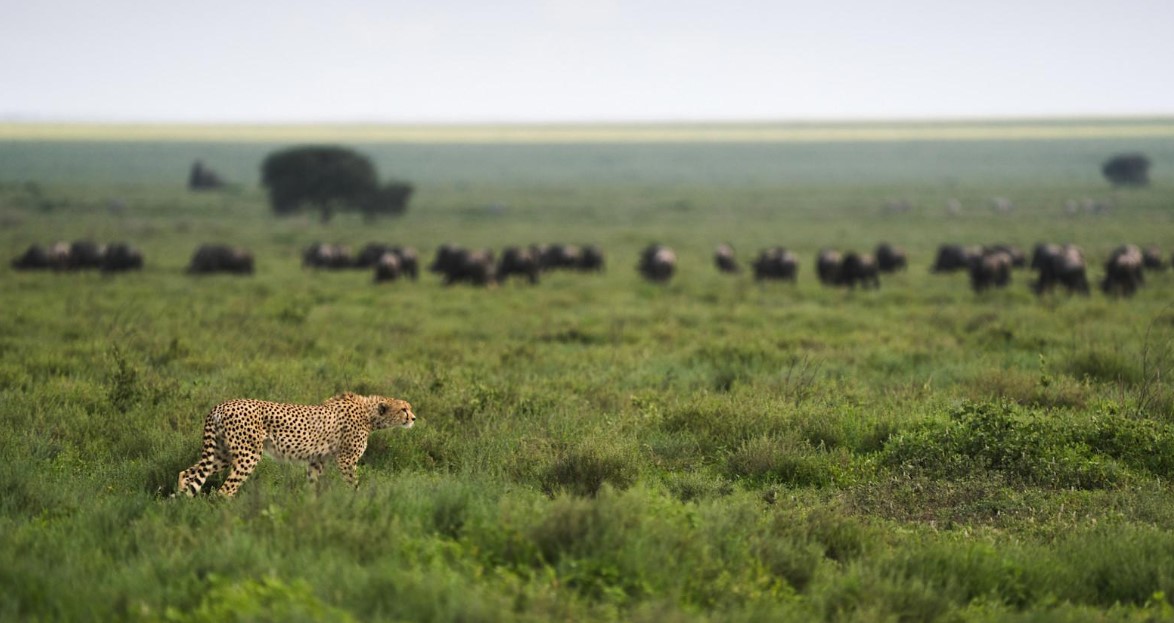
Leopards are frequently searched for around riverine woodland, while lions can be found resting on rocky kopjes or following herbivore herds across the plains. Cheetahs generally prefer open areas where they can use speed to hunt.
The Great Migration is not a single event with a fixed location. It is a continuous movement involving wildebeest, zebras and other grazing animals. Their position changes with rainfall, grazing conditions and the timing of the seasons.
A general migration calendar looks like this:
| Period | General area | Possible highlights |
|---|---|---|
| December–March | Ndutu and southern ecosystem | Calving, predator activity and large herds |
| April–May | Central and western areas | Green landscapes and moving herds |
| June–July | Western and northern corridors | Herd movement and possible river crossings |
| August–October | Northern Serengeti | Possible Mara River crossings |
| November | Central and eastern areas | Herds returning south after seasonal rain |
These movements are natural and never guaranteed. A knowledgeable safari company should explain the likely location of the herds without promising a particular crossing or kill.
Ruaha National Park is one of Tanzania’s finest wilderness areas. The park is distinguished by baobab-covered landscapes, rugged hills and the Great Ruaha River, which becomes an essential gathering point for wildlife during the dry season.
Unlike the broad, predominantly open plains commonly associated with the Serengeti, Ruaha presents a mixture of habitats. Miombo woodland meets East African savannah, creating varied scenery and supporting an impressive range of animals.
Ruaha is particularly celebrated for elephants and predators. Travelers may encounter:
Wild dogs are among Africa’s most endangered carnivores. They roam across large territories, which means sightings can never be guaranteed, but Ruaha remains one of Tanzania’s important wild-dog habitats.
The park is also situated in a transition zone where wildlife associated with eastern and southern Africa can occur. This contributes to Ruaha’s unusual animal diversity.
The Great Ruaha River is one of the park’s defining natural features. During the dry season, animals concentrate around the river and remaining water sources. Elephants dig into sandy riverbeds to locate underground water, while predators patrol areas where prey is most abundant.
Hippos and crocodiles inhabit the deeper pools. Lions, leopards and other predators take advantage of the concentration of herbivores.
TANAPA describes the river as the park’s lifeline and highlights the June-to-October dry period as an important wildlife-viewing season. Official Ruaha visitor information
Ruaha generally receives fewer visitors than the Serengeti. On some game drives, travelers may spend considerable time without encountering another vehicle.
This makes Ruaha particularly attractive to:
Low visitor numbers do not mean wildlife sightings are automatic. Ruaha is enormous, and its vegetation can sometimes make animals more challenging to locate. A skilled local guide is therefore especially valuable.
Although both parks provide outstanding wildlife viewing, their safari experiences are different.
| Feature | Serengeti | Ruaha |
|---|---|---|
| Safari circuit | Northern Circuit | Southern Circuit |
| Famous for | Great Migration and open plains | Elephants, predators and remote wilderness |
| Visitor numbers | Moderate to high in popular seasons | Generally lower |
| Landscape | Grasslands, kopjes and river valleys | Baobabs, woodland, rivers and rugged hills |
| Wildlife viewing | Abundant and often easier to locate | Wild, rewarding and sometimes more challenging |
| Main gateway | Arusha or Kilimanjaro | Dar es Salaam or Iringa |
| Ideal stay | Three to five nights | Three to four nights |
| Best for | First safaris and migration enthusiasts | Repeat visitors, photographers and solitude seekers |
The Serengeti often delivers a high number of sightings within a relatively short period. Ruaha rewards patient exploration and creates a stronger sense of remoteness.
Neither park is objectively better. They complement each other, which is precisely why combining them can produce such a memorable safari.
This is one of the most important planning questions. The parks are far apart and do not form a practical direct road-safari route for most travelers.
Driving from the Serengeti to Ruaha would involve long transfers and potentially overnight stops. It can be incorporated into an extended overland expedition, but it is rarely the best option for a normal holiday.
Domestic flights are usually the most practical solution. An itinerary may connect the Serengeti with Ruaha through Arusha, Dar es Salaam or another flight hub, depending on the current seasonal schedule.
The exact route can change according to:
A domestic “flight” between safari regions may include more than one landing to collect or drop off passengers. Small aircraft also have stricter luggage restrictions than international airlines. Soft-sided bags are strongly recommended.
Because schedules and routings can change, your Serengeti safari Ruaha company should confirm the operating flight before finalizing the safari.
A practical journey can follow this sequence:
The itinerary can also operate in reverse. Travelers arriving through Dar es Salaam may begin in Ruaha and finish in the Serengeti before departing through Kilimanjaro International Airport.
A rushed itinerary can reduce the value of combining these two distant destinations. Each park deserves several game drives, and at least part of one day may be needed for the transfer between circuits.
A minimum of approximately eight safari days is advisable. Ten to twelve days provides a more comfortable experience.
Day 1: Arrival in Arusha
Meet your representative at Kilimanjaro International Airport and transfer to your Arusha accommodation.
Day 2: Fly to Serengeti
Take a morning flight into the Serengeti. Meet your guide at the airstrip and begin your first game drive.
Days 3–4: Serengeti
Enjoy morning and afternoon game drives, concentrating on the best wildlife areas for the season.
Day 5: Fly toward Ruaha
Transfer to the airstrip and fly to Ruaha. Your Ruaha guide will meet you upon arrival.
Days 6–7: Ruaha
Explore the river, woodland and baobab-covered landscapes on game drives.
Day 8: Departure
Fly from Ruaha to Dar es Salaam or Zanzibar.
This arrangement works, but it leaves limited room for schedule changes and provides only a brief introduction to each park.
Day 1: Arrival in Arusha
Airport pickup, safari briefing and overnight in Arusha.
Day 2: Tarangire National Park
Travel to Tarangire for elephant viewing and a game drive among baobab trees.
Day 3: Ngorongoro Crater
Descend into the crater for a full or extended game drive before continuing to your accommodation.
Day 4: Serengeti National Park
Enter the Serengeti and enjoy an afternoon game drive.
Days 5–6: Serengeti exploration
Explore the most suitable region according to the season and wildlife movements.
Day 7: Serengeti to Ruaha
Fly between the safari circuits and transfer to your Ruaha camp.
Days 8–9: Ruaha National Park
Enjoy full days of game viewing. Depending on your camp and park regulations, optional walking or night experiences may be available.
Day 10: Ruaha to Dar es Salaam or Zanzibar
Complete a final short activity if the flight schedule permits, then fly onward.
A twelve-day journey can include:
This slower itinerary gives you more time to observe animal behavior, respond to seasonal conditions and enjoy your camps rather than constantly packing and transferring.
The most suitable period depends on your wildlife interests, budget and tolerance for rain.
The dry season is generally the easiest period for combining the parks.
In Ruaha, animals gather near rivers and permanent water sources as smaller seasonal sources disappear. Vegetation becomes less dense, which can improve visibility.
In the Serengeti, the migration may be found in the western, central or northern regions depending on the month and rainfall. July through October is associated with northern migration viewing, although exact herd positions remain unpredictable.
Advantages include:
Possible disadvantages include:
Short rains refresh the landscapes and can create dramatic skies for photography. Migratory birds arrive, and the Serengeti herds generally begin moving toward the southern ecosystem.
Rain is usually intermittent rather than continuous, but road and flight conditions can vary.
The southern Serengeti and Ndutu region can provide outstanding wildlife viewing during this period. Thousands of wildebeest calves are born, attracting lions, cheetahs and hyenas.
Ruaha may be green and beautiful, but wildlife can be more widely dispersed because water is available throughout the landscape. Some camps may also operate seasonally, so availability must be confirmed.
This is Tanzania’s wetter period. Advantages may include greener scenery, fewer visitors and promotional accommodation rates.
However:
Travel is still possible, but the itinerary should be designed by a company with current knowledge of camp operations and transport schedules.
Both parks offer accommodation ranging from public campsites to exclusive luxury lodges.
Public camping can reduce the cost of a Serengeti safari. A typical camping package may provide:
Camping is more commonly integrated into Northern Circuit road safaris. Including public camping in a combined Serengeti–Ruaha itinerary requires careful planning because the domestic flight may limit the amount of equipment that can be transported.
Separate equipment or crews may be required in each circuit.
Mid-range tented camps usually provide:
These camps offer a strong balance between comfort and immersion in nature.
Luxury properties may include:
Luxury prices vary significantly according to season, location and whether domestic flights are included.
Planning a budget Ngorongoro Crater safari holiday from Arusha? Compare a crater day trip, a two-day Tarangire and Ngorongoro safari, or a…
Read articleA Tanzania safari from Zanzibar can mean a short mainland trip during your beach holiday or a complete package with flights, game…
Read articleLooking for a group Tanzania safari price from Kilipath African Safaris? A published example for our four-day shared camping safari through Tarangire,…
Read articlePair game drives on Tanzania’s mainland with a few days on Zanzibar’s coast. With Kilipath African Safaris, you can start in Arusha…
Read article

