

Budget Ngorongoro Crater Safari Holiday
Planning a budget Ngorongoro Crater safari holiday from Arusha? Compare a crater day trip, a two-day Tarangire and Ngorongoro safari, or a…
Read articleArusha City - Tanzania
Safari & Travel Tips
September 1, 2026 · 15 min read
Planning a Tanzania safari does not always mean choosing between the famous Northern Circuit and the remote Southern Circuit. Travelers with enough time can experience both regions in one itinerary, creating a journey filled with elephants, baobab forests, predators, rivers, wilderness and dramatically different landscapes.
This is where Tarangire safari Southern Circuit planning becomes particularly interesting.
Tarangire National Park is located in northern Tanzania and is especially famous for its elephants, ancient baobab trees, seasonal wildlife concentrations and the Tarangire River. Southern Tanzania, meanwhile, offers enormous wilderness areas such as Ruaha and Nyerere National Parks.
Combining these regions allows travelers to experience two distinct sides of Tanzania.
In Tarangire, safari drives reveal rolling savannah, huge baobabs, elephant families and wildlife gathering around permanent water sources. Farther south, Ruaha introduces immense landscapes, the Great Ruaha River, predators and comparatively remote game-viewing areas. Nyerere adds yet another dimension with the Rufiji River system, where visitors can combine conventional game drives with boat safari experiences.
The key is planning the route correctly.
Because Tarangire and the Southern Circuit are separated by considerable distances, a successful itinerary requires realistic travel times, sensible use of domestic flights and enough days to avoid turning your holiday into a sequence of transfers.
This guide explains how to plan it.
Tarangire National Park lies in northern Tanzania, within easy reach of Arusha.
It covers roughly 2,850 square kilometers and is renowned for its combination of river valleys, swamps, woodland, open plains and dramatic baobab landscapes.
TANAPA's visitor information places Tarangire approximately 2.5–3 hours by road from Arusha, depending on conditions and the route taken. Kuro Airstrip inside the park also accommodates scheduled and charter safari flights.
For most international travelers, the journey starts through either:
Tarangire is normally combined with Lake Manyara, Ngorongoro Crater and Serengeti National Park.
However, travelers with approximately 8–14 days can extend their journey into southern Tanzania.
No.
This is one of the most important things travelers should understand when researching Tarangire safari Southern Circuit planning.
Tarangire belongs to Tanzania's Northern Circuit. TANAPA's Northern Zone includes Tarangire, Lake Manyara, Kilimanjaro, Arusha and Mkomazi National Parks.
Southern safari destinations generally include areas such as:
Ruaha National Park
One of Tanzania's great wilderness destinations, characterized by huge landscapes, the Great Ruaha River, elephants, buffalo, predators and excellent birdlife.
Nyerere National Park
A vast wilderness associated with the Rufiji River, lakes, floodplains and forests. Visitors can encounter lions, elephants, buffalo, hippos, crocodiles and African wild dogs, while boat safaris provide a completely different experience from traditional game drives.
Depending on the itinerary, travelers may also consider destinations around Mikumi, Udzungwa, Iringa or other southern Tanzania areas.
Therefore, a Tarangire–Southern Circuit safari should be viewed as a combined Northern and Southern Tanzania safari, rather than a single-circuit itinerary.
There is an excellent reason.
Tarangire offers ecological and photographic experiences that complement rather than duplicate southern Tanzania.
Tarangire is especially associated with elephants. During the dry season, animals become increasingly dependent on permanent water sources and large numbers can gather within the ecosystem.
TANAPA describes Tarangire as an elephant heartland and highlights its large elephant populations.
Watching a large elephant family moving beneath ancient baobabs can become one of the defining memories of a Tanzania safari.
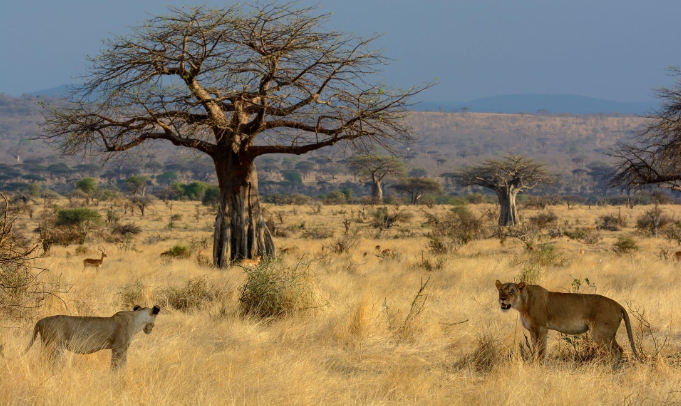
Few northern Tanzanian safari destinations feature baobabs as dramatically as Tarangire.
The enormous trees create spectacular photography opportunities, particularly during sunrise and late afternoon.
Ruaha also contains impressive baobab country, meaning travelers who combine Tarangire and Ruaha can observe how these landscapes change across different ecosystems.
The Tarangire River acts as an important water source during the dry months.
Wildebeest, zebra, hartebeest and other herbivores move through the ecosystem as surrounding areas become drier. Wildlife concentration around water can make July through October especially rewarding.
Tarangire is also a strong birdwatching destination. TANAPA reports more than 550 recorded bird species in the park.
Combining it with Ruaha and Nyerere produces a particularly diverse safari for bird enthusiasts.
Tarangire provides a classic northern Tanzania experience while Ruaha and Nyerere introduce a much more expansive southern wilderness atmosphere.
Together, they make a safari feel much more varied.
Wildlife is the main reason most travelers include Tarangire in their Tanzania itinerary.
Elephants are Tarangire's signature species.
You may encounter solitary bulls, mothers with calves or large family groups moving through woodland and river valleys.
Observing elephants interacting naturally is particularly rewarding because safari vehicles sometimes encounter them at close—but safe—viewing distances.
Lions occur throughout Tarangire and may be seen resting beneath trees, stalking prey around river systems or relaxing in open grassland.
Termite mounds also provide elevated observation points for predators.
Leopards are present but generally more difficult to find than lions.
Experienced guides search riverine woodland and areas with suitable trees where leopards may rest during the hotter part of the day.
Cheetahs can occur in open areas where visibility allows them to hunt.
Sightings cannot be guaranteed, making each encounter particularly rewarding.
Large buffalo herds are among Tarangire's impressive dry-season attractions.
Giraffes are regularly encountered and create beautiful photography opportunities against baobab and acacia landscapes.
Seasonal movements bring substantial numbers into the wider Tarangire ecosystem, particularly when water becomes scarce outside the park.
Other animals may include:
Wildlife sightings are always natural and can never be guaranteed, which is part of what makes a genuine African safari exciting.
Tarangire is open throughout the year, but conditions change dramatically by season.
For many first-time visitors, this is the strongest period for wildlife viewing.
As seasonal water disappears, animals increasingly depend on permanent resources such as the Tarangire River and Silale Swamp.
This can create impressive wildlife concentrations.
July, August, September and October are particularly popular.
Advantages include:
The disadvantage is demand.
Popular lodges and camps can become busy, so accommodation should be reserved early.
The landscapes become greener as seasonal rainfall begins.
Wildlife may become more dispersed, but the park is beautiful and birding improves.
This period can offer a quieter safari experience.
These months can provide warm temperatures, attractive landscapes and excellent birding.
Combining Tarangire with the wider northern region is also attractive during this period because travelers interested in seasonal migration movements may incorporate Ndutu farther north.
These are typically wetter months.
Tarangire remains beautiful and dramatically green, but road conditions can be more challenging in some areas. TANAPA recommends 4×4 vehicles during wet conditions.
There may also be fewer visitors.
For photographers, the combination of green scenery, dramatic skies and reduced traffic can be very rewarding.
For a combined Tarangire, Ruaha and Nyerere safari, June through October is usually the easiest window for travelers focused primarily on classic wildlife viewing.
Ruaha's peak safari months also generally fall within the dry season, when animals congregate around reliable water sources.
TANAPA recommends booking Ruaha accommodation early for the June–October peak period.
This makes July through October particularly convenient because wildlife viewing conditions can be strong in both northern and southern Tanzania.
However, travelers interested in birdlife, landscapes and fewer vehicles should not automatically dismiss the wetter seasons.
Travelers sometimes wonder whether visiting both is necessary because both contain elephants and baobabs.
The experience is actually very different.
Tarangire is relatively easy to access from Arusha.
Its highlights include:
Ruaha is much larger and more remote.
TANAPA states that Ruaha covers approximately 20,226 square kilometers, making it one of Tanzania's great wilderness areas.
Highlights include:
Ruaha provides an excellent contrast after Tarangire.
These destinations are even more different.
Tarangire is largely about classic vehicle-based safari exploration through woodland, river environments and baobab country.
Nyerere's defining geographical feature is the Rufiji River system.
One major attraction is the possibility of a boat safari.
TANAPA highlights boating along the Rufiji as one of Nyerere's characteristic experiences, allowing visitors to encounter hippos, crocodiles, elephants and abundant birdlife from the water.
Wildlife can include:
For this reason, Tarangire + Nyerere works particularly well for travelers seeking variety rather than simply maximizing the number of game drives.
For Tarangire alone, travelers should ideally consider one to two full safari days.
A one-day safari can cover the major northern game-viewing areas.
However, staying overnight allows:
For a combined Tarangire and Southern Circuit itinerary, approximately 8–12 days provides a much better experience.
Shorter combinations are possible, particularly with domestic flights.
Arrive at Kilimanjaro International Airport.
Meet your safari representative and transfer to your accommodation in Arusha.
Rest after your international flight and receive a safari briefing.
After breakfast, depart toward Tarangire.
Enter the park and begin your first game drive.
Search for elephants, giraffes, zebra, buffalo and predators while exploring the baobab landscapes.
Overnight near or inside Tarangire.
Spend the day exploring deeper sections of the park.
Visit river circuits and areas around Silale where wildlife concentrations can be particularly rewarding.
Overnight Tarangire.
Depending on the selected itinerary, return toward Arusha and connect with a domestic flight, or structure the trip via another flight hub.
Using flights is usually preferable to spending excessive safari time on long road transfers.
Begin your Southern Circuit adventure with morning and afternoon game drives.
Explore riverine habitats, woodland and open wilderness.
Spend an entire day searching for elephants, lions, buffalo, leopards and other wildlife.
Ruaha's size means additional time greatly improves the experience.
Enjoy another morning game drive.
Travelers with more time could continue onward to Nyerere instead of completing the safari here.
Fly from the safari region toward Dar es Salaam or Zanzibar and continue with your beach holiday or international journey.
Travelers with more time could use:
Day 1: Arrive Arusha
Day 2: Tarangire National Park
Day 3: Tarangire National Park
Day 4: Transfer/fly south
Day 5: Ruaha National Park
Day 6: Ruaha National Park
Day 7: Fly to Nyerere
Day 8: Nyerere game drive
Day 9: Boat safari + game drive
Day 10: Fly to Dar es Salaam or Zanzibar
This format gives travelers considerably more variety.
For most travelers, flying is the better option when combining Tarangire and the Southern Circuit.
The reason is simple: distance.
A conventional Northern Circuit safari uses Arusha as its major gateway, while southern Tanzania itineraries are commonly connected through Dar es Salaam and regional airstrips.
Driving all the way between regions can consume valuable holiday time.
Domestic safari flights reduce long transfer days and allow travelers to spend more time watching wildlife.
Tarangire itself has Kuro Airstrip, while Ruaha has safari airstrips including Msembe and Jongomero.
Your operator should build connections around the flight schedules available on your exact dates.
There is accommodation for almost every safari style.
Budget travelers can use:
Camping keeps costs lower while providing a genuine wilderness atmosphere.
Mid-range accommodation normally provides:
This category often provides the best balance between comfort and value.
Luxury safaris may include:
Inside Tarangire, accommodation options range from campsites to lodges and tented camps around areas such as the Tarangire River and Silale region.
Tarangire offers more than standard game drives.
Available activities can include:
The classic way to explore the park.
A pop-up-roof safari vehicle allows excellent visibility and photography.
Walking experiences are available in designated areas and must follow park regulations with authorized guides or rangers.
TANAPA lists night game drives among Tarangire's visitor experiences.
Night drives provide opportunities to experience an entirely different side of the ecosystem.
Tarangire is particularly suitable for photography because of its:
Balloon experiences are also offered in Tarangire, subject to availability and operating conditions.
Combining Tarangire with southern Tanzania expands your activity choices.
In Ruaha, visitors may enjoy:
TANAPA specifically lists game drives, designated-zone walking, birding and photographic safaris among Ruaha experiences.
In Nyerere, activities may include:
The boat safari is one of the most distinctive additions to a combined Tanzania itinerary.
A 4x4 safari Land Cruiser is ideal.
Typical safari vehicles feature:
During wet conditions, a true 4x4 becomes particularly important because some safari roads can become muddy.
TANAPA specifically recommends 4×4 access for Tarangire during the wetter months.
Pack light and focus on practical clothing.
Useful items include:
Early morning game drives can be surprisingly cool.
Neutral colors such as beige, khaki, olive and brown are generally suitable for safari.
A private safari is the strongest choice for a complicated Northern + Southern Circuit journey.
Advantages include:
Families, couples, honeymooners and photographers frequently prefer this option.
Planning a budget Ngorongoro Crater safari holiday from Arusha? Compare a crater day trip, a two-day Tarangire and Ngorongoro safari, or a…
Read articleA Lake Manyara safari can cost USD 150–220 per person for a shared day trip from Arusha. A published example of a…
Read articleA Tanzania safari from Zanzibar can mean a short mainland trip during your beach holiday or a complete package with flights, game…
Read articleLooking for a group Tanzania safari price from Kilipath African Safaris? A published example for our four-day shared camping safari through Tarangire,…
Read article

