Lake Manyara vs. Nyerere Safari Prices | Tanzania Guide
A Lake Manyara safari can cost USD 150–220 per person for a shared day trip from Arusha. A published example of a…
Read articleArusha City - Tanzania
Safari & Travel Tips
September 1, 2026 · 19 min read
A Lake Manyara safari Tanzania vacation is one of the most rewarding ways to experience the remarkable variety of landscapes and wildlife found along Tanzania's famous Northern Safari Circuit.
Located beneath the dramatic escarpment of the Great Rift Valley, Lake Manyara National Park combines lush groundwater forest, acacia woodland, wetlands, floodplains, hot springs and an alkaline lake within a relatively compact safari destination. Tanzania National Parks describes the park as covering approximately 648.7 square kilometres and highlights its groundwater forest, tree-climbing lions, seasonal flamingos and Rift Valley scenery among its signature attractions.
Unlike destinations where you may spend many hours driving across huge open plains, Lake Manyara constantly changes around you. You can enter beneath tall forest trees filled with monkeys and birds, continue toward woodland where elephants and giraffes may appear, and eventually reach open areas overlooking the lake and the towering Rift Valley escarpment.
This diversity makes Lake Manyara particularly suitable for travelers who want to experience several different Tanzanian habitats during one safari.
It is also ideally positioned for combining with other famous destinations including:
Whether you are planning a short one-day safari or incorporating Manyara into a longer Tanzania wildlife vacation, the park provides an excellent introduction to northern Tanzania.
Travelers frequently focus first on Serengeti and Ngorongoro when planning a Tanzania safari. Those destinations are extraordinary, but Lake Manyara offers something noticeably different.
Its main strength is ecological diversity.
Within one game drive, visitors can experience forest, woodland, marsh, lake, escarpment and open grassland habitats.
TANAPA specifically identifies the park's groundwater forest, alkaline lake, Great Rift Valley escarpment, hot springs, hippo pools, wetlands and acacia woodland as major attractions.
That diversity creates opportunities to encounter everything from tiny colorful birds to large elephants.
Tree-climbing lions
Lake Manyara is famous for lions occasionally resting in acacia and other trees.
Elephant encounters
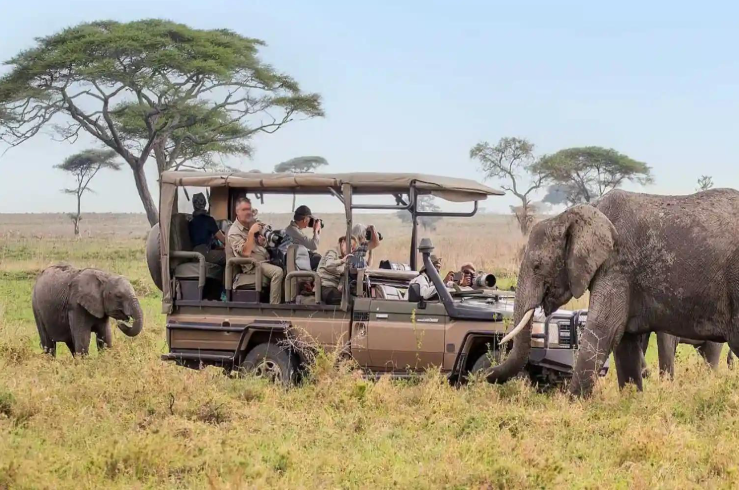
The park is particularly well known for elephants, sometimes encountered surprisingly close to the safari road.
Exceptional birdlife
Wetlands, woodland and forest support an impressive range of bird species.
Flamingos
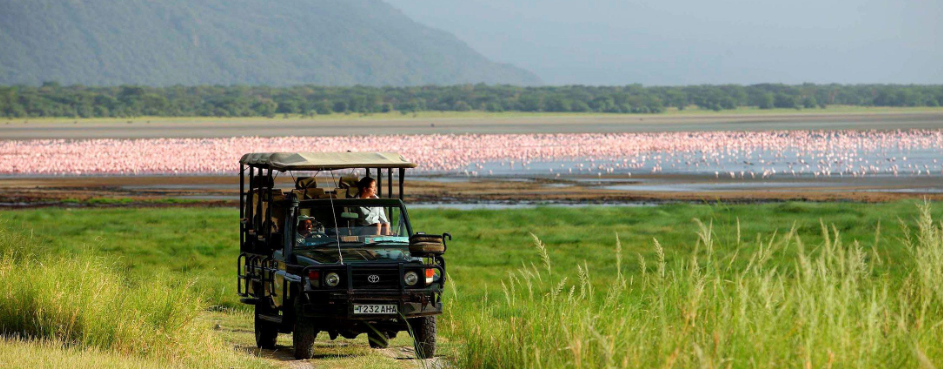
Depending on water conditions and season, pink flamingos can gather around the alkaline lake.
Hippos
Wetland areas and hippo pools provide opportunities to observe these enormous semi-aquatic mammals.
Great Rift Valley scenery
The dramatic escarpment rising above the park creates spectacular backgrounds for photography.
Groundwater forest
Visitors entering the park encounter an environment very different from the stereotypical dry African savannah.
Convenient location
Lake Manyara is around 125 km from Arusha, with TANAPA estimating approximately 2–2.5 hours of road travel under normal conditions.
For travelers with limited time, this makes Manyara particularly attractive.
Lake Manyara National Park sits along Tanzania's Northern Circuit near the town of Mto wa Mbu.
The park lies below the western escarpment of the Great Rift Valley.
The contrast between this towering escarpment, green forest and shallow alkaline lake gives Manyara one of Tanzania's most distinctive landscapes.
According to TANAPA, freshwater springs emerging around the base of the escarpment help support the park's evergreen groundwater forest. Further into the park, the vegetation transitions through woodland, wetlands, floodplains and the lakeshore.
This ecological variation is one reason travelers can encounter such diverse wildlife within a relatively small area.
Wildlife is naturally the main reason most travelers choose a Lake Manyara safari Tanzania vacation.
While wildlife encounters can never be guaranteed, Lake Manyara supports many of northern Tanzania's characteristic animals.
TANAPA lists elephants, buffaloes, zebras, wildebeest and giraffes among animals that can be found around the park's floodplains and other habitats.
Elephants are among Lake Manyara's most memorable residents.
The park's mixture of forest, woodland and open areas provides good feeding habitat for them.
You may encounter:
Because dense vegetation covers parts of Manyara, an elephant can occasionally emerge from the forest remarkably close to the vehicle.
These encounters can produce extraordinary photography opportunities while your professional safari guide maintains a respectful and safe viewing distance.
Lake Manyara has become internationally associated with tree-climbing lions.
Visitors sometimes find lions resting on broad tree branches during the warmer part of the day.
The behavior is not guaranteed, and lions do climb trees elsewhere in Africa, but tree-resting lions have long been associated with Manyara. TANAPA continues to feature tree-climbing lions as one of the park's signature wildlife attractions.
Several explanations are often proposed for this behavior, including:
Whatever the reason, discovering a large lion stretched across an acacia branch is one of the most exciting sightings visitors can experience.
Because these encounters are unpredictable, travelers should regard them as a special bonus rather than a guaranteed part of every game drive.
Lake Manyara's alkaline waters can support large numbers of waterbirds.
Among the most famous are:
These elegant birds are recognizable by their bright pink appearance and specialized feeding behavior.
Larger and generally paler than lesser flamingos, they can also occur around the lake.
When conditions are suitable, flamingos gathering together can create a spectacular pink band across the water.
However, flamingo numbers vary according to:
Therefore, travelers should never plan their entire Lake Manyara safari around the assumption that enormous flamingo concentrations will always be present.
TANAPA describes flamingo viewing as seasonal and also notes pelicans and numerous other waterbirds around the lake.
Bird lovers should seriously consider including Manyara in a Tanzania itinerary.
The combination of forest, woodland, wetlands and lake habitat attracts an extraordinary variety of species.
TANAPA reports more than 400 bird species recorded in the park.
Birds visitors may potentially encounter include:
Even travelers who do not consider themselves serious birdwatchers often become fascinated by Manyara's colorful species.
A knowledgeable safari guide can help identify birds and explain their feeding behavior, calls and habitat.
One of the first wildlife experiences visitors may have after entering Lake Manyara is encountering primates.
The groundwater forest provides excellent habitat for:
Large troops can sometimes be seen feeding, grooming and moving along roads or through the woodland.
Young baboons playing together can be especially entertaining.
These forest-dwelling monkeys are frequently associated with the greener sections of Manyara.
Because primates may approach picnic areas, visitors should never feed wildlife or leave food unattended.
TANAPA specifically advises guests not to feed animals and notes that baboons and monkeys are common near picnic areas.
Lake Manyara's wetlands support hippos.
At designated viewing areas, travelers may watch hippos resting in shallow water while birds move around the wetland.
Hippos spend much of the daytime in water because their skin is sensitive to heat and sunlight.
Despite their heavy appearance, hippos can be extremely dangerous.
Visitors should therefore remain only in permitted viewing areas and follow their guide's instructions.
Giraffes are another striking species that can be seen around Lake Manyara.
Watching a giraffe move slowly through acacia woodland beneath the Rift Valley escarpment creates one of the classic images of a Tanzania safari.
Travelers may observe giraffes:
African buffalo are regularly associated with Manyara's grasslands, wetlands and woodland.
Large bulls may sometimes be observed near marshy areas.
Buffaloes are exceptionally powerful animals, and guides always maintain an appropriate distance.
TANAPA specifically mentions buffalo among the characteristic mammals of the park.
Open floodplains around the lake may support zebras and wildebeest.
Although Lake Manyara does not experience the enormous Great Migration spectacle associated with Serengeti, observing plains game beneath the Rift Valley escarpment is still beautiful.
Depending on conditions, you may see animals grazing alongside:
Leopards occur in Lake Manyara but can be difficult to spot.
Their spotted coats provide excellent camouflage among branches, bushes and shadows.
Finding one therefore requires patience, sharp eyesight and sometimes a little luck.
Other predators may occur throughout the wider ecosystem, although sightings vary significantly.
Your guide will watch for tracks, animal behavior and other signs that could indicate a predator nearby.
One feature that immediately distinguishes Manyara from other parks is its green groundwater forest.
Freshwater springs emerging around the Rift Valley support lush vegetation, including impressive mature trees.
TANAPA describes this forest as home to blue monkeys, baboons, bushbuck and numerous birds.
Driving through the forest can feel entirely different from exploring Serengeti or Tarangire.
The atmosphere is:
Wildlife can appear suddenly between the trees, adding excitement to the experience.
The western wall of the Great Rift Valley rises dramatically beside Lake Manyara.
This massive geological feature provides one of the most impressive natural backdrops on northern Tanzania's safari circuit.
At certain viewpoints, visitors can see:
Landscape photographers often appreciate Manyara because wildlife can be photographed against this dramatic background.
Toward the southern part of the park are hot springs known as Maji Moto.
The springs are associated with the geological activity of the Great Rift Valley.
TANAPA identifies the hot springs as one of the park's natural highlights.
They offer an interesting contrast to wildlife viewing and demonstrate how geology has shaped the park's environment.
The game drive is the centerpiece of almost every Lake Manyara safari.
After entering the park, your guide follows designated roads while searching for wildlife.
A typical drive may move through several ecological zones.
Watch for:
Possible sightings include:
Look for:
Possible sightings include:
Depending on water conditions:
Your professional safari guide will adapt the drive according to wildlife movements and road conditions.
Your safari begins after breakfast with pickup from your hotel in Arusha.
Meet your professional safari guide and board your private or shared 4x4 safari vehicle.
The drive from Arusha toward Lake Manyara normally takes approximately 2–2.5 hours, depending on traffic and road conditions. TANAPA gives a similar estimate and places the park roughly 125 km from Arusha.
Along the way, enjoy views of:
After park registration, begin your game drive.
The entrance immediately introduces you to the beautiful groundwater forest.
Your guide begins searching for wildlife and explaining the ecosystem.
Possible early sightings include:
Continue toward the more open sections of the park.
Search for:
Your guide may stop whenever wildlife activity becomes interesting.
Safari is not simply about ticking animals off a list. Some of the most memorable moments happen when you stop and watch behavior.
You may observe:
Enjoy lunch at an authorized picnic area.
Depending on your safari package, this may be a packed lunch or a prepared meal.
Take time to relax while enjoying the natural surroundings.
Remember that wild animals, particularly monkeys and baboons, should never be fed.
Continue exploring.
Depending on road conditions and your route, the afternoon may include wetlands, viewpoints and lakeshore areas.
Search for hippos and waterbirds and enjoy panoramic Rift Valley scenery.
After completing the game drive, exit the park and drive back to Arusha.
Arrival is usually during the late afternoon or early evening depending on your exact schedule.
Your Lake Manyara safari adventure concludes with hotel drop-off.
Travelers with two days can combine Lake Manyara with one of Africa's greatest wildlife destinations: Ngorongoro Crater.
Enjoy a full or extended game drive at Lake Manyara.
Afterward, travel toward Karatu for dinner and overnight.
After an early breakfast, drive to Ngorongoro Conservation Area.
Descend into Ngorongoro Crater for a game drive.
The crater supports exceptional concentrations of wildlife including:
After the game drive, return to Arusha.
This combination is ideal for travelers who have limited time but want two contrasting ecosystems.
A three-day safari provides an excellent introduction to Tanzania's Northern Circuit.
Explore Tarangire, famous for elephants, baobab landscapes and the Tarangire River ecosystem.
Overnight near Karatu or another suitable location.
Explore Manyara's forest, woodland, lake and wetlands.
Search for tree-climbing lions, elephants, hippos, primates and birds.
Overnight near Karatu.
Descend into Ngorongoro Crater for your final wildlife experience.
Return to Arusha afterward.
Travelers seeking the classic northern Tanzania experience should consider a longer safari.
A popular structure is:
Game drive and overnight near Karatu.
Travel through the Ngorongoro highlands toward Serengeti.
Spend an entire day searching for wildlife.
Morning game viewing followed by transfer toward Ngorongoro.
Crater game drive and return to Arusha.
This provides a much broader Tanzania wildlife experience.
Serengeti and Manyara are very different.
Lake Manyara offers:
Serengeti offers:
Combining both prevents your safari from feeling repetitive.
Manyara and Ngorongoro make an excellent combination because they are geographically convenient and ecologically different.
Lake Manyara's appeal is its changing habitats.
Ngorongoro's appeal comes from the remarkable concentration of wildlife inside an ancient volcanic caldera.
Travelers can therefore experience:
Day 1: forest, lake and Rift Valley
Day 2: crater floor and open grassland
It is particularly good for short Tanzania safaris.
Tarangire is another excellent partner.
The scenery changes dramatically between the parks.
Tarangire is famous for:
Manyara provides:
Together, they showcase just how diverse northern Tanzania can be.
A popular Tanzania vacation combines wildlife safari with relaxation on Zanzibar.
For example:
Explore Tanzania's Northern Circuit.
Fly to Zanzibar.
Relax on beaches and explore cultural attractions.
This itinerary allows travelers to combine:
It is particularly popular with:
A private safari provides maximum flexibility.
You receive:
Private safaris work especially well for:
Your guide can spend additional time at interesting sightings without needing to coordinate with unrelated travelers.
A shared safari can be ideal for budget-conscious travelers.
Instead of paying for the vehicle privately, safari costs are divided among several participants.
A shared safari generally provides:
Shared trips generally follow a fixed program and offer less flexibility than private safaris.
They are especially suitable for:
A proper wildlife safari should use a vehicle designed for game viewing.
A typical Tanzania safari vehicle is a customized 4x4 Land Cruiser.
Useful features commonly include:
The pop-up roof allows travelers to stand safely inside the vehicle and photograph animals more easily.
Your Lake Manyara safari Tanzania vacation can be customized for different comfort levels.
Budget packages may use:
This option keeps costs relatively low while focusing on wildlife viewing.
Mid-range safaris usually use comfortable lodges or tented camps.
Rooms typically include:
This is one of the most popular safari categories because it balances comfort and price.
Luxury packages can include high-end lodges and tented camps with:
These packages are ideal for honeymooners and travelers celebrating special occasions.
Travelers can stay in several areas.
Very convenient for Lake Manyara and cultural activities.
A popular safari town between Lake Manyara and Ngorongoro.
Karatu offers a wide range of:
A limited number of safari accommodations allow travelers to stay closer to the wilderness.
TANAPA notes that accommodation is available both inside the broader park area and in nearby locations such as Mto wa Mbu and Karatu.
Game drives are the main activity, but additional experiences may be available.
TANAPA currently highlights activities including daytime game drives, birdwatching, canopy walking and photography.
The classic safari activity.
Search for wildlife from your 4x4 vehicle while moving through various habitats.
An excellent choice because of the park's rich bird diversity.
Lake Manyara includes a canopy walkway experience, giving visitors a different perspective of forest vegetation and wildlife. TANAPA describes viewing decks positioned through the trees along the walkway.
Manyara's combination of animals, woodland, lake and escarpment creates outstanding photographic possibilities.
Night drives may be available where permitted and arranged according to park regulations.
Mto wa Mbu is located close to Lake Manyara.
Travelers can combine their safari with a cultural experience.
Depending on the program, activities may include:
This adds cultural depth to a wildlife-focused itinerary.
Lake Manyara National Park can be visited throughout the year. TANAPA's visitor information describes the park as open year-round, while historical park guidance identifies the dry seasons as particularly popular.
Each season provides a slightly different experience.
Generally considered part of the drier period.
Advantages can include:
This is also part of Tanzania's peak safari season.
Short rains can turn the landscapes greener.
Advantages include:
Rainfall varies from year to year.
Often a good period for northern Tanzania travel.
Conditions may be warm and relatively dry between rain periods.
This period also works particularly well if combining Manyara with southern Serengeti or Ndutu during the broader migration calving season.
These months typically include Tanzania's long rains.
Advantages can include:
However, heavy rainfall can affect road conditions and access to some routes.
For many travelers, half a day to one full day is enough to enjoy the principal areas of Lake Manyara.
This makes the park particularly useful as part of a multi-destination itinerary.
Consider:
Suitable if traveling onward to Karatu or another nearby destination.
Best for travelers wanting slower wildlife viewing and birdwatching.
Useful when combining Manyara with additional activities around Mto wa Mbu.
Lake Manyara is well suited to family safaris.
Because the park is relatively compact and can be reached conveniently from Arusha, children do not necessarily need to spend an entire day traveling.
Family safaris can be customized with:
A private safari is usually the best option for families because the schedule can be adjusted according to children's energy levels.
Couples can combine Manyara with romantic safari lodges and longer Northern Circuit itineraries.
A typical couple's itinerary could include:
For honeymooners, accommodation can be selected according to privacy, scenic location and romantic atmosphere.
Photographers benefit particularly from a private safari.
Lake Manyara provides opportunities to photograph:
A private vehicle allows more flexibility when waiting for good lighting or interesting animal behavior.
Pack light, practical clothing.
Recommended items include:
Neutral colors such as:
are generally practical for safari.
Photography enthusiasts may want:
For wildlife photography, a telephoto lens is useful.
A wide-angle lens is valuable for capturing the Rift Valley landscape.
Exact inclusions depend on your chosen package, but a safari may include:
Always check your quotation carefully before booking.
Unless specifically included, prices may exclude:
Your final quotation should clearly show all inclusions and exclusions.
There is no single fixed price for a Lake Manyara safari because cost depends on several factors.
Private safari costs are divided among the people sharing the vehicle.
Therefore, per-person costs normally decrease when more people travel together.
A one-day safari costs less than a multi-day Northern Circuit safari.
Budget camps, mid-range lodges and luxury properties have very different prices.
High-season accommodation can cost more than low-season accommodation.
Adding Serengeti, Ngorongoro or Tarangire increases total park, vehicle, fuel and accommodation costs.
For an accurate price, request a personalized quotation based on:
A successful safari requires far more than simply booking a vehicle.
Careful planning affects:
With Kilipath African Safaris, your itinerary can be customized around your actual travel plans.
We can assist with:
Our goal is to create a smooth safari from your arrival in Tanzania until your final transfer.
A Lake Manyara safari Tanzania vacation combines wildlife, extraordinary scenery and one of the most diverse small ecosystems on Tanzania's Northern Safari Circuit.
From elephants walking beneath the forest canopy to baboons beside the road, giraffes crossing open grassland, hippos resting in wetlands and flamingos gathering along the alkaline lake, every section of Manyara offers a different experience.
The towering Great Rift Valley escarpment makes the landscape even more impressive.
Lake Manyara can be enjoyed as:
Whether you are a solo traveler, couple, honeymooner, family or group of friends, the itinerary can be customized according to your available time and budget.
Send us:
Travel dates:
Number of adults:
Number and ages of children:
Number of safari days:
Preferred accommodation: Budget / Mid-range / Luxury
Private or shared safari:
Arrival airport:
Other destinations you want to visit:
We can then prepare a personalized Lake Manyara safari Tanzania vacation package designed around your travel plans.
A Lake Manyara safari can cost USD 150–220 per person for a shared day trip from Arusha. A published example of a…
Read articlePlanning a Tanzania safari that combines Lake Manyara National Park and Nyerere National Park is an excellent way to experience the country's…
Read articlePlanning an unforgettable African wildlife adventure from Zanzibar? Understanding the Tanzania safari package Zanzibar price is an important first step toward choosing…
Read articlePlanning an African wildlife adventure? Understanding the group Tanzania safari price is an important step toward choosing an affordable and unforgettable safari…
Read article