

Budget Ngorongoro Crater Safari Holiday
Planning a budget Ngorongoro Crater safari holiday from Arusha? Compare a crater day trip, a two-day Tarangire and Ngorongoro safari, or a…
Read articleArusha City - Tanzania
Safari & Travel Tips
September 1, 2026 · 13 min read
A Tarangire safari Arusha deal is one of the easiest and most rewarding ways to experience Tanzania's wildlife if you are staying in Arusha or beginning a longer Northern Circuit safari. Tarangire National Park combines enormous elephant herds, ancient baobab trees, riverine woodland, open savannah, seasonal wetlands, predators, and prolific birdlife in a destination that can be visited as a day trip or included in a multi-day safari.
Tarangire covers approximately 2,850 square kilometres, and the Tarangire River runs through the park. The river becomes especially important during the dry months, when wildlife concentrates around remaining water sources. Tanzania National Parks describes Tarangire as particularly famous for its elephants, baobab landscapes and dry-season concentrations of wildlife.
For travelers arriving in Arusha, Tarangire is also conveniently located. TANAPA's visitor information indicates that the park is roughly 2.5–3 hours by road from Arusha, making an early-morning departure practical for a full-day game drive.
Whether you are searching for an affordable shared safari, a comfortable private safari, a family trip or a luxury Tarangire experience, there are several ways to build a package around your budget.
Arusha is the main starting point for safaris across northern Tanzania. From here, travelers can conveniently reach Tarangire, Lake Manyara, Ngorongoro Conservation Area and Serengeti National Park.
A Tarangire safari beginning in Arusha is particularly attractive because you can leave the city in the morning and start seeing wildlife the same day.
A typical trip may include:
Private safaris can also be customized with accommodation, airport transfers, additional parks, cultural activities or Zanzibar extensions.
Tarangire sometimes receives less international attention than Serengeti and Ngorongoro, but experienced safari travelers know how rewarding the park can be.
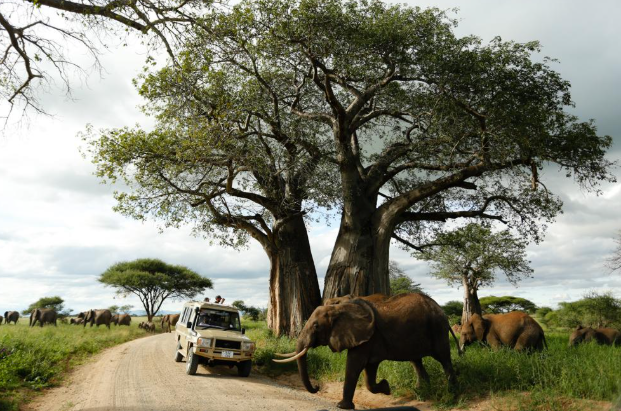
Elephants are Tarangire's signature attraction.
The park supports major elephant populations, and travelers may see families walking toward the river, young calves surrounded by adults, bulls feeding beneath trees or entire herds crossing safari tracks.
TANAPA describes Tarangire as one of Tanzania's outstanding destinations for elephant viewing.
A patient safari guide can often spend significant time observing the elephants' natural behavior rather than simply stopping for photographs and moving on.
Tarangire's landscape is instantly recognizable because of its enormous baobab trees.
Their unusually thick trunks and dramatic branches create classic African safari scenery. Some areas combine baobabs, elephants and golden savannah in a single view, producing excellent photography opportunities.
These trees are more than scenery. They provide habitat and resources for insects, birds and mammals and are an important part of the Tarangire ecosystem.
The Tarangire River is one of the park's ecological lifelines.
During the dry season, animals from surrounding areas move toward dependable water, increasing wildlife concentrations around the river and nearby habitats.
Wildebeest, zebra, buffalo and other herbivores can gather in considerable numbers during favorable periods.
Predators naturally benefit from these concentrations too.
Tarangire is not simply an endless grassland.
During one safari you may travel through:
This diversity creates habitats for many different animals and gives photographers constantly changing scenery.
Wildlife sightings are never guaranteed because Tarangire is a natural ecosystem, but travelers commonly search for:
Tarangire's most famous residents and often one of the highlights of the trip.
Lions occur throughout the ecosystem and may be found resting beneath trees, moving across open country or watching prey near water sources.
More elusive than lions, but possible to encounter with patience and luck.
Occasionally seen in suitable open landscapes.
Both individual bulls and larger herds may be encountered.
Frequently observed browsing from acacia trees and woodland.
Particularly noticeable when animals concentrate during drier periods.
Seasonal movement brings wildebeest into important parts of the greater Tarangire ecosystem.
Regularly spotted running through open areas with their tails raised.
Common around woodland and riverine habitats.
Visitors may encounter impala, waterbuck, dik-dik and other antelope species.
Yes.
Tarangire is considered an excellent destination for birding because of its varied woodland, grassland, river and wetland habitats.
Depending on the season and location, travelers can search for raptors, hornbills, storks, kingfishers, ostriches and many smaller species.
For dedicated bird photographers, tell your safari company before departure. Your guide can then spend additional time identifying birds rather than concentrating only on large mammals.
Tarangire can be visited throughout the year, but the experience changes significantly by season.
This is generally one of the strongest periods for concentrated wildlife viewing.
As surrounding areas become dry, animals increasingly depend on permanent or reliable water sources.
Advantages can include:
The tradeoff is higher visitor demand and greater competition for popular accommodations.
TANAPA recommends booking well in advance during the peak dry-season months.
Short rains can transform the landscape.
Vegetation becomes greener and photographic conditions can be beautiful. Visitor numbers may also be lower than during peak dry-season months.
Rain generally does not mean continuous rainfall every day; conditions vary from year to year.
These months can still provide very rewarding game viewing and often combine warm weather with attractive landscapes.
If you are planning a larger Northern Circuit itinerary, this period can also work well for combining Tarangire with southern Serengeti or Ndutu depending on wildlife movements.
This is Tanzania's wetter period.
Advantages may include:
Some tracks may become muddy, however, making a capable 4×4 vehicle especially useful.
TANAPA recommends 4×4 travel during wet conditions.
A one-day Tarangire safari is ideal for travelers with limited time.
Your guide collects you from your hotel.
After a short briefing, you begin the drive toward Tarangire National Park.
After registration at the park entrance, your game drive begins.
Your guide will search for elephants, giraffes, zebras, buffalo, antelopes, lions and other wildlife.
Rather than following an absolutely fixed route, safari guides normally adjust the drive according to recent sightings, road conditions and wildlife movements.
Lunch is normally enjoyed at an authorized picnic location.
Depending on your package, lunch may be a packed picnic or arranged hot meal.
The afternoon offers another opportunity to explore riverine habitats, baobab areas and wildlife-rich plains.
You exit the park and begin the drive back to Arusha.
Arrival is normally in the evening depending on traffic, game-drive length and your exact hotel location.
Travelers who have additional time can spend a night near or inside the Tarangire ecosystem.
Depart Arusha and enjoy an extended Tarangire game drive.
After the safari, continue to your lodge, tented camp or campsite for dinner and overnight.
Enjoy another wildlife experience before returning to Arusha.
Alternatively, continue to Lake Manyara or Ngorongoro rather than returning directly to the city.
A two-day option provides more relaxed wildlife viewing than a fast day trip.
A popular short Northern Circuit itinerary combines three different ecosystems.
Full or extended game drive followed by overnight near Karatu, Mto wa Mbu or Tarangire.
Descend into the Ngorongoro Crater for wildlife viewing.
This gives travelers the opportunity to search for lions, buffalo, hippos, zebras, wildebeest and many other species.
Visit Lake Manyara National Park before returning to Arusha.
This combination works well for travelers who want variety but don't have enough time to drive deep into Serengeti.
Travelers who want the classic Tanzania safari experience should consider combining Tarangire with Serengeti and Ngorongoro.
A possible itinerary is:
Day 1: Arusha → Tarangire
Day 2: Tarangire/Karatu → Serengeti
Day 3: Serengeti → Ngorongoro area
Day 4: Ngorongoro Crater → Arusha
For a less rushed safari, five or six days is even better.
A private safari means your vehicle and guide are dedicated to your booking.
This is ideal for:
Private trips usually provide greater control over when you leave, how long you remain at wildlife sightings and where you stop.
For wildlife photographers, this flexibility can be especially valuable.
A shared safari can reduce costs by splitting vehicle expenses among travelers.
It is especially popular among:
Shared safaris normally operate with fixed schedules and less flexibility than private trips.
Before booking, ask:
A clear quotation makes comparing different Tarangire safari Arusha deals much easier.
A budget Tarangire safari focuses spending on wildlife experiences rather than luxury accommodation.
Budget packages may use:
Camping safaris can be very enjoyable for adventurous travelers who want to remain close to nature.
Always check whether tents, mattresses, sleeping bags, meals and camping fees are included.
Mid-range safaris balance affordability and comfort.
Accommodation generally offers:
Exact standards differ by property, so request photographs and accommodation names before confirming your safari.
Luxury safaris emphasize privacy, location, service and accommodation quality.
Depending on the camp or lodge, travelers may enjoy:
Luxury does not necessarily produce more animals; it changes the comfort and exclusivity surrounding your wildlife experience.
Before paying, request a complete written list of inclusions.
A comprehensive package commonly includes:
Transport: 4×4 safari vehicle.
Guide: Professional safari driver-guide.
Park fees: Relevant conservation/entry fees when specified in the quotation.
Meals: According to the itinerary.
Drinking water: During the safari.
Game drives: As described in your itinerary.
Accommodation: When booking an overnight package.
Government taxes: Where specified.
Transfers: Depending on your agreed package.
Do not assume every quotation includes identical services simply because the headline price appears similar.
Typical exclusions can include:
Always use the specific quotation supplied by your safari operator as the final authority.
There is no single price for every traveler.
The cost depends on:
A two-person private safari normally costs more per traveler than a safari divided among four or six passengers because vehicle and guide expenses are shared among fewer people.
For the most accurate Tarangire safari Arusha deal, request a quotation based on your exact travel date and group size.
Yes.
Tarangire can be an excellent family destination, especially because children often enjoy seeing elephants at relatively close but safe viewing distances.
Families should consider:
Some lodges have age restrictions for certain activities, particularly walking safaris, so confirm these before booking.
Absolutely.
A private Tarangire safari can be combined with boutique lodges, sunset experiences and luxury tented accommodation.
A popular honeymoon combination is:
Arusha → Tarangire → Serengeti → Ngorongoro → Zanzibar
This creates a trip combining safari adventure with a relaxing Indian Ocean beach stay.
Most quality Tanzania safari operators use 4×4 Land Cruisers modified for wildlife viewing.
Useful safari-vehicle features include:
The pop-up roof allows travelers to stand safely inside the vehicle while photographing wildlife.
Comfortable neutral-colored clothing is recommended.
Pack:
Neutral colors such as khaki, beige, brown, olive and grey generally work well.
TANAPA also advises visitors to bring sun protection and insect repellent and recommends neutral-colored clothing, particularly in tsetse areas.
Binoculars greatly improve any safari.
Large elephants may be close enough to see easily, but binoculars help you observe:
Ask your safari company whether binoculars are supplied in the vehicle or whether you should bring your own.
Safari visits are generally conducted under established park rules and with professional guides.
Visitors should:
TANAPA specifically advises travelers to give elephants and buffalo adequate space and to leave vehicles only at designated locations unless participating in an authorized activity.
Authorized walking safaris are available in designated circumstances.
These provide a completely different perspective from vehicle-based game drives, allowing guests to learn about tracks, plants, insects, animal behavior and smaller ecological details.
Walking activities must be conducted with appropriate authorized personnel and should be arranged in advance.
Tarangire offers balloon safari experiences, subject to operator schedules, weather and availability.
Flying over baobab landscapes and wildlife habitats at sunrise can be spectacular.
TANAPA lists balloon safaris among experiences available in Tarangire.
Because capacity is limited, reservations are best made well before travel.
They offer different experiences.
Tarangire is particularly associated with elephants, baobabs and concentrated dry-season wildlife.
Serengeti offers enormous open plains, major predator populations and the seasonal Great Migration ecosystem.
Rather than choosing between them, travelers with sufficient time should include both.
Again, the landscapes are very different.
Tarangire provides a broad wilderness ecosystem characterized by woodland, river environments and baobabs.
Ngorongoro involves descending into a massive volcanic caldera containing dense wildlife concentrations.
Combining both gives a much richer Tanzania safari experience.
It may be possible depending on:
However, travelers arriving on long international flights often prefer one night in Arusha before starting safari.
This reduces stress and allows you to begin the next morning rested.
The most common gateways are:
Convenient for domestic flights and connections to Zanzibar and other Tanzanian destinations.
The main international gateway serving northern Tanzania.
Your safari operator can arrange a transfer to Arusha before your Tarangire safari.
A full day works well for first-time visitors.
However, one or two nights gives you more time to explore less-busy sections of the park and experience different wildlife conditions during morning and afternoon game drives.
Travelers with five to eight days can combine Tarangire with Serengeti and Ngorongoro for a complete Northern Circuit safari.
Advance booking becomes particularly important during June–October and Christmas/New Year periods.
Popular lodges and tented camps can fill quickly.
Booking early provides:
TANAPA likewise advises advance accommodation reservations for the peak dry season.
Tarangire is an excellent introduction to Tanzania's Northern Safari Circuit.
Imagine leaving Arusha in the morning, watching enormous elephant families wandering between ancient baobabs, seeing giraffes feeding among acacia trees, stopping beside the Tarangire River and scanning the savannah for lions before enjoying lunch surrounded by some of East Africa's most memorable scenery.
Whether you have only one day or are building a complete 5-, 6- or 7-day Tanzania safari, Tarangire deserves serious consideration.
For a personalized Tarangire safari Arusha deal, provide your:
Travel date + number of travelers + number of safari days + preferred accommodation level — budget, mid-range or luxury.
A customized itinerary can then be prepared around your schedule and budget.
Planning a budget Ngorongoro Crater safari holiday from Arusha? Compare a crater day trip, a two-day Tarangire and Ngorongoro safari, or a…
Read articleA Lake Manyara safari can cost USD 150–220 per person for a shared day trip from Arusha. A published example of a…
Read articleA Tanzania safari from Zanzibar can mean a short mainland trip during your beach holiday or a complete package with flights, game…
Read articleLooking for a group Tanzania safari price from Kilipath African Safaris? A published example for our four-day shared camping safari through Tarangire,…
Read article

