

Budget Ngorongoro Crater Safari Holiday
Planning a budget Ngorongoro Crater safari holiday from Arusha? Compare a crater day trip, a two-day Tarangire and Ngorongoro safari, or a…
Read articleArusha City - Tanzania
Safari & Travel Tips
September 2, 2026 · 14 min read
A Lake Manyara safari and Ngorongoro travel experience is one of the easiest ways to discover two completely different wildlife environments within Tanzania's famous Northern Safari Circuit.
Lake Manyara National Park sits below the dramatic Great Rift Valley escarpment and combines groundwater forest, acacia woodland, wetlands, open floodplains and an alkaline lake. Ngorongoro, meanwhile, is famous for its enormous volcanic crater, spectacular highlands and exceptionally concentrated wildlife.
Because the destinations are relatively close to one another, they work perfectly together in a short Tanzania safari. Travelers can spend one day exploring Lake Manyara and continue toward Karatu or Ngorongoro for an overnight stay before descending into Ngorongoro Crater the following morning.
This Lake Manyara safari Ngorongoro travel guide explains how to plan the journey, what animals you may encounter, the best months to visit, accommodation options, safari duration and how the combination fits into a longer Northern Tanzania itinerary.
Lake Manyara and Ngorongoro complement each other because their landscapes and wildlife experiences are noticeably different.
The Ngorongoro Conservation Area Authority describes Ngorongoro Crater as the world's largest intact and unfilled volcanic caldera, with more than 25,000 animals reported across its ecosystem.
Together, the destinations create an excellent introduction to Tanzanian wildlife.
Lake Manyara National Park is situated along Tanzania's Northern Safari Circuit near the town of Mto wa Mbu.
The park lies beneath the steep western wall of the Great Rift Valley.
According to TANAPA, Lake Manyara National Park covers approximately 648.7 square kilometres and contains several contrasting habitats, including groundwater forest, wetlands, floodplains, acacia woodland and the alkaline lake itself.
Its comparatively compact size makes Manyara particularly suitable for half-day or full-day game drives.
Lake Manyara became internationally known for lions occasionally resting in acacia trees.
Seeing them is never guaranteed because wildlife moves naturally throughout the ecosystem.
Nevertheless, searching for tree-climbing lions remains one of the highlights of a Lake Manyara safari.
TANAPA specifically identifies tree-climbing lions as one of the park's notable wildlife attractions.
Elephants are another major attraction.
They may appear along forest tracks, woodland areas and open spaces closer to the lake.
Because vegetation can sometimes be dense, encounters may occur unexpectedly as safari vehicles turn around corners.
Watching elephants against the backdrop of the Rift Valley is particularly memorable.
Lake Manyara is an alkaline or soda lake.
Depending on water levels, food availability and seasonal conditions, flamingos may gather around parts of the shoreline.
Travelers should remember that flamingos are seasonal rather than guaranteed.
Pelicans, storks, herons, spoonbills and many other waterbirds can also occur.
TANAPA reports hundreds of bird species across Manyara's wetlands, forests and woodland habitats.
Bird lovers should allow enough time around wetlands and forest areas.
Possible species include:
The combination of lake, forest and savannah environments makes Manyara one of the most interesting birding stops on Tanzania's Northern Circuit.
Immediately after entering the park, visitors often drive through lush woodland supported by underground water flowing from the Rift Valley highlands.
Huge fig and mahogany trees create an environment completely different from the open plains travelers may later encounter in Serengeti or Ngorongoro.
Blue monkeys and baboons are commonly associated with these forested habitats.
TANAPA highlights the groundwater forest as one of Lake Manyara's defining ecosystems.
The escarpment rising behind Lake Manyara creates one of the park's most dramatic landscapes.
The contrast between:
lake + forest + wildlife + steep Rift Valley cliffs
gives photographers excellent opportunities.
Travelers driving from Arusha toward Manyara also begin seeing impressive Rift Valley scenery before entering the park.
Lake Manyara has wetlands where visitors may observe hippos, particularly around designated viewing areas.
Birdlife is also excellent around these habitats.
Visitors should always remain in approved areas and follow ranger instructions because hippos are powerful and potentially dangerous wild animals.
TANAPA advises visitors to remain inside safari vehicles except at designated points and maintain appropriate distance around elephants and hippo pools.
Game driving is the main safari experience, but additional activities may include:
Lake Manyara has a canopy walkway that offers visitors a different perspective of the forest.
Particularly rewarding around wetlands and forest zones.
Excellent because several landscapes occur within a relatively small park.
Some areas provide opportunities to appreciate the lake and surrounding Rift Valley landscape.
The nearby town can be added for travelers interested in local food, farming and community experiences.
Night drives may be offered in designated areas subject to regulations and availability.
Lake Manyara is approximately 125 km from Arusha.
Driving usually takes around:
2–2.5 hours
depending on traffic, road conditions and the exact starting point.
The route is mostly paved and passes through attractive northern Tanzanian countryside.
The main entrance is located close to Mto wa Mbu.
This is where the combination becomes especially convenient.
After completing a Lake Manyara game drive, many safari itineraries continue uphill toward:
Karatu is commonly used as an overnight base because it has numerous accommodation options.
A typical schedule could look like:
Morning: Depart Arusha
Late morning–afternoon: Lake Manyara game drive
Late afternoon: Drive toward Karatu
Evening: Dinner and overnight
Next morning: Ngorongoro Crater safari
This minimizes unnecessary driving and creates an efficient safari route.
Ngorongoro is not simply a national park.
It is a large multiple-use conservation area containing:
The conservation area covers approximately 8,292 square kilometres, according to the Ngorongoro Conservation Area Authority.
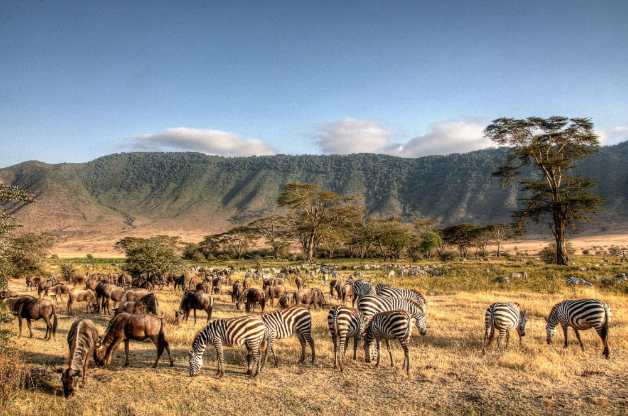
Ngorongoro Crater is the main wildlife attraction.
Vehicles descend from the highlands to the crater floor for game viewing.
At the bottom, travelers encounter open grassland, lakes, swamps and woodland.
These varied environments support an impressive concentration of wildlife.
Animals commonly searched for include:
Leopards are present within the wider conservation area but can be difficult to see.
Ngorongoro is widely regarded as one of Tanzania's strongest destinations for seeing several iconic African animals during a single game drive.
Potentially, yes.
The Big Five are:
Ngorongoro is especially important for travelers hoping to see black rhinos.
However, no ethical safari operator can guarantee sightings of all five animals because wildlife is completely free-ranging.
Leopards are often the most challenging member of the Big Five to locate around the crater.
The possibility of encountering a black rhino is one of Ngorongoro's major attractions.
They may appear at considerable distance, so binoculars can be extremely helpful.
Safari guides usually communicate with other guides and observe open areas carefully when searching for rhinos.
Photographers should consider bringing a longer telephoto lens.
Lions are among the crater's most exciting predators.
Because grazing animals occur in significant numbers, predators can remain relatively concentrated within suitable territories.
Visitors may encounter:
Early morning is particularly atmospheric for wildlife viewing.
Spotted hyenas are frequently encountered.
They play an important ecological role both as predators and scavengers.
Watching interactions between hyenas and lions can become one of the most interesting experiences during a crater safari.
Large elephant bulls can sometimes be seen within the crater, especially around woodland zones.
The surrounding Ngorongoro highlands also support elephant movement.
The sight of an elephant framed against the crater wall is a favorite subject for wildlife photographers.
Hippos inhabit freshwater areas on the crater floor.
Certain picnic areas may offer views across pools where hippos rest during the day.
Always remain within officially designated visitor areas.
Lake Magadi is a shallow alkaline lake located on the crater floor.
Depending on seasonal conditions, it can attract flamingos and other waterbirds.
The NCAA identifies Lake Magadi as an important birding feature within Ngorongoro.
Both destinations can be visited throughout the year.
However, the experience changes with the seasons.
Generally drier months.
Advantages include:
July, August and September can be busy because they correspond with Tanzania's high safari season.
Short rains may begin.
The landscape becomes greener and birding can improve.
Rain normally does not mean nonstop rainfall throughout every day.
Often attractive months for:
These months also coincide with calving activity farther west and northwest around southern Serengeti/Ndutu, making it possible to extend your itinerary.
These are generally the wetter months.
Advantages may include:
Some safari roads can become more challenging after heavy rainfall.
Ngorongoro itself can still be visited throughout the year, including rainy periods.
| Feature | Lake Manyara | Ngorongoro |
|---|---|---|
| Landscape | Lake, forest, woodland | Volcanic crater and highlands |
| Elephants | Excellent | Good |
| Lions | Present | Excellent |
| Rhinos | Extremely unlikely | One of the main attractions |
| Flamingos | Seasonal | Seasonal around Lake Magadi |
| Primates | Very good | Limited |
| Birding | Excellent | Excellent |
| Safari duration | Half/full day | Usually major portion of a day |
| Scenery | Rift Valley | Crater panorama |
| Best for | Diverse habitats | Dense wildlife |
The biggest reason to visit both is variety.
Your safari begins in Arusha.
Travel toward Mto wa Mbu and enter Lake Manyara National Park.
Spend the day exploring:
Watch for elephants, baboons, monkeys, giraffes, buffalo and possibly tree-climbing lions.
After the game drive, continue toward Karatu.
Dinner and overnight.
Begin early.
Drive toward Ngorongoro and enjoy the spectacular crater viewpoint before descending.
Spend several hours searching for:
Enjoy lunch at an approved picnic area.
Later, ascend the crater and return toward Arusha.
Travelers wanting a slower experience can add another destination.
Day 1: Tarangire
Day 2: Lake Manyara
Day 3: Ngorongoro
Excellent for travelers who have limited time.
Day 1: Lake Manyara
Day 2: Ngorongoro
Day 3: Local cultural or walking experience
Better for travelers who prefer a slower itinerary.
For many visitors, Lake Manyara and Ngorongoro form part of a longer Northern Circuit safari.
A popular itinerary is:
Arusha → Lake Manyara
Karatu → Serengeti
Full-day Serengeti
Serengeti → Ngorongoro
Ngorongoro Crater → Arusha
This combination gives travelers lake habitats, Rift Valley scenery, Serengeti plains and crater wildlife.
Tarangire is particularly famous for:
A classic route is therefore:
Arusha → Tarangire → Lake Manyara → Serengeti → Ngorongoro → Arusha
Travelers can choose among several styles.
Suitable for travelers prioritizing safari experiences over luxury.
Options may include:
One of the most popular choices.
Typically includes:
Karatu contains many popular mid-range lodges.
Luxury options may feature:
Some premium properties are located directly on or close to the Ngorongoro crater rim.
Advantages:
Advantages:
Disadvantage:
For budget or mid-range travelers, Karatu often provides the best value.
Best for:
Advantages include:
Best for travelers trying to reduce costs.
Advantages:
However, shared safaris are less flexible because passengers follow a fixed itinerary.
A typical Northern Tanzania safari uses a 4x4 Land Cruiser with a pop-up roof.
The raised roof allows travelers to stand while observing and photographing wildlife.
Useful safari vehicle features can include:
Packages vary, but many include:
Always check exactly what is included before confirming.
Depending on the operator and package, travelers may need to budget for:
There is no single fixed price.
Safari costs depend on:
A private safari becomes more economical per person when several travelers share one vehicle.
For example, four travelers sharing a private Land Cruiser normally have a lower per-person transport cost than a solo traveler using the same vehicle.
Yes, particularly when the traveler values:
Travelers focused almost exclusively on large predators sometimes prioritize Serengeti or Ngorongoro instead.
But Manyara provides something those destinations do not: a compact combination of forest, escarpment, wetland and lake habitats.
For first-time Tanzania safari visitors, absolutely.
Few destinations combine dramatic scenery and concentrated wildlife as effectively.
The first view from the crater rim alone can become one of the highlights of a Tanzania holiday.
The most common starting point is Arusha.
Arusha serves as the gateway to Northern Circuit destinations including:
Visitors normally arrive through:
Kilimanjaro International Airport (JRO)
or
Arusha Airport (ARK)
Yes.
Travelers staying in Zanzibar can fly to northern Tanzania and combine their beach holiday with a safari.
A typical arrangement involves:
Zanzibar → Arusha flight → safari → Zanzibar
or, for longer itineraries:
Zanzibar → Arusha → Manyara → Serengeti → Ngorongoro → Arusha → Zanzibar
Domestic flight schedules should always be checked for the specific travel date.
Bring lightweight, comfortable clothing.
Useful items include:
Ngorongoro lies at considerably higher elevation than Lake Manyara.
Mornings and evenings around the crater rim can feel cold.
A fleece or lightweight insulated jacket is highly recommended.
Once visitors descend to the crater floor, temperatures usually become warmer.
Photograph:
Photograph:
A zoom lens covering approximately 100–400 mm is extremely useful for wildlife photography.
A wider lens is valuable for landscape scenes.
Always remember that these are protected ecosystems.
Travelers should:
Off-road driving is restricted in Ngorongoro, and visitors should follow official road and conservation regulations.
Both destinations work well for families.
Lake Manyara's varied scenery helps keep children interested, while Ngorongoro provides a strong chance of seeing multiple animals within a comparatively compact area.
Parents should bring:
Private safaris usually provide families with greater flexibility.
This combination can also suit honeymoon safaris.
Couples can upgrade to:
It can then be combined with several relaxing days in Zanzibar.
Photographers should strongly consider a private safari.
Advantages include greater flexibility to remain longer at interesting sightings.
Ask your safari operator about:
A Lake Manyara safari Ngorongoro travel experience offers far more than simply visiting two protected areas.
Lake Manyara introduces travelers to the lush side of Tanzania's Northern Circuit: groundwater forests, elephants, primates, wetlands, flamingos and the towering Great Rift Valley escarpment.
Ngorongoro then presents a completely different spectacle—a vast volcanic crater containing extraordinary wildlife concentrations surrounded by dramatic highland scenery.
For travelers with only two or three safari days, the combination provides exceptional variety without requiring extremely long travel distances. Those with additional time can extend the route naturally into Tarangire and Serengeti.
Whether you are planning your first African safari, a family holiday, a honeymoon, a photographic journey or a safari-and-Zanzibar combination, Lake Manyara and Ngorongoro deserve a prominent place on your Tanzania itinerary.
Planning a budget Ngorongoro Crater safari holiday from Arusha? Compare a crater day trip, a two-day Tarangire and Ngorongoro safari, or a…
Read articleA Lake Manyara safari can cost USD 150–220 per person for a shared day trip from Arusha. A published example of a…
Read articleA Tanzania safari from Zanzibar can mean a short mainland trip during your beach holiday or a complete package with flights, game…
Read articleLooking for a group Tanzania safari price from Kilipath African Safaris? A published example for our four-day shared camping safari through Tarangire,…
Read article

