

Budget Ngorongoro Crater Safari Holiday
Planning a budget Ngorongoro Crater safari holiday from Arusha? Compare a crater day trip, a two-day Tarangire and Ngorongoro safari, or a…
Read articleArusha City - Tanzania
Safari & Travel Tips
September 2, 2026 · 17 min read
A Nyerere National Park safari Ngorongoro adventure combines two remarkably different sides of Tanzania. In the south, Nyerere offers vast wilderness, the Rufiji River, boat safaris, elephants, hippos, crocodiles, lions, and opportunities to search for African wild dogs. In northern Tanzania, the Ngorongoro Conservation Area delivers dramatic volcanic scenery and some of the country's most concentrated wildlife viewing.
For travelers who want more than a standard northern-circuit itinerary, combining Nyerere and Ngorongoro creates a varied safari experience. One day you may be cruising quietly along the Rufiji River as elephants appear beside the water; later in the journey, you can descend through the forested wall of Ngorongoro Crater to watch lions, buffalo, wildebeest, zebras, hyenas, hippos, and potentially black rhinos.
Tanzania National Parks describes Nyerere as a vast southern wilderness of more than 30,000 square kilometers, characterized by miombo woodland, floodplains, channels, lakes, and the Rufiji River. TANAPA also highlights African wild dogs, lions, elephants, buffalo, hippos, crocodiles, and more than 430 bird species among its wildlife attractions.
Ngorongoro, meanwhile, is famous for its immense volcanic crater. The Ngorongoro Conservation Area Authority identifies the area as home to the Big Five and says the crater supports a large concentration of wildlife.
Together, these destinations create an adventure based on contrast: river and crater, southern wilderness and northern highlands, boating and traditional game drives.
Travelers sometimes wonder whether it makes sense to combine destinations that belong to two different safari regions.
It certainly can—especially when the goal is a more diverse Tanzanian safari rather than simply visiting the greatest possible number of parks.
A Nyerere and Ngorongoro itinerary offers several advantages.
Nyerere is characterized by a combination of:
Ngorongoro provides almost the opposite landscape.
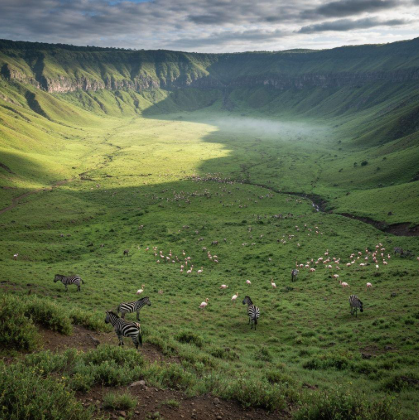
You travel through rolling Tanzanian highlands before reaching a giant volcanic caldera surrounded by steep crater walls. After stopping at viewpoints along the rim, safari vehicles descend hundreds of meters toward the crater floor.
That geographical contrast makes the journey especially attractive for photographers and repeat safari travelers.
Traditional African safaris are strongly associated with game drives.
Nyerere expands the experience.
Depending on your itinerary and operating conditions, activities can include:
Game drives
Explore woodland, floodplains and river systems searching for elephants, lions, giraffes, buffalo and other animals.
Boat safaris
Cruise portions of the Rufiji River system, often seeing hippos, crocodiles, waterbirds and animals approaching the banks.
Guided walking experiences
Selected guided walking activities may be available under appropriate park regulations and with authorized guides.
Ngorongoro then provides one of Tanzania's classic vehicle-based wildlife experiences: a game drive across the crater floor.
TANAPA specifically lists boat safaris on the Rufiji as one of Nyerere's signature experiences and requires authorized guides for boating and walking activities.
The two areas also complement one another in terms of wildlife.
Nyerere is particularly exciting for travelers hoping to encounter:
TANAPA identifies Nyerere as one of East Africa's important strongholds for African wild dogs.
Ngorongoro is attractive because considerable numbers of animals occupy a relatively compact area.
Possible sightings include:
The NCAA notes that most of the area's major wildlife species can occur on the crater floor, although giraffes are generally absent from it.
A successful Nyerere National Park safari Ngorongoro adventure normally begins by giving Nyerere enough time.
Trying to rush through the park in one afternoon wastes much of what makes it special.
The Rufiji shapes much of the character of Nyerere.
Rather than being simply a river cutting through a dry savannah, it creates channels, wetlands, lakes, sandbanks and fertile riverine habitats.
This attracts wildlife throughout the year.
During a boat safari, visitors may observe hippos surfacing nearby, Nile crocodiles resting on sandbanks and African fish eagles watching from trees.
Elephants can sometimes approach the riverbanks to drink.
The experience is quieter than a vehicle game drive and allows visitors to observe the ecosystem from an entirely different angle.
One of the greatest attractions of Nyerere is the possibility of seeing African wild dogs.
These highly social predators move across large territories, meaning sightings can never be guaranteed. However, Nyerere remains one of Tanzania's important landscapes for the species.
For wildlife enthusiasts who have already seen lions, elephants and zebras elsewhere, searching for wild dogs can become one of the most memorable parts of the journey.
Elephants are another major highlight.
Groups may be encountered:
Around the Rufiji system, the combination of elephants and water creates particularly impressive photography opportunities.
Nyerere also has lions.
Their behavior can vary according to prey distribution, temperatures and season.
Early morning drives are particularly enjoyable because temperatures are cooler and predators may still be active after the night.
Leopards and hyenas are also present, although sightings depend on luck and the skill of your safari guide.
Nyerere is highly rewarding for birdwatchers.
TANAPA records more than 430 bird species in the park and highlights fish eagles, bee-eaters, wetland birds and other river-associated species.
Visitors who initially arrive interested only in mammals often discover that bird photography becomes an unexpected highlight.
For many travelers, the boat safari is the feature that makes Nyerere different from Serengeti, Tarangire or Ngorongoro.
Imagine heading toward the river as afternoon temperatures begin to fall.
The boat moves slowly through the water.
Hippos may appear ahead while crocodiles remain motionless on exposed banks. Colorful kingfishers move rapidly over the water and African fish eagles call from trees.
You may see giraffes, monkeys, elephants or antelope close to the riverbank.
Sunset can make the experience particularly atmospheric.
Instead of watching animals from behind a vehicle door, you are experiencing the landscape at water level.
For travelers building a combined Nyerere and Ngorongoro itinerary, a boat safari is worth prioritizing rather than treating as an optional extra.
After the southern safari, the journey changes completely.
Ngorongoro lies in northern Tanzania and contains volcanic highlands, forests, archaeological locations, Maasai cultural landscapes and the world-famous crater.
The Ngorongoro Conservation Area covers approximately 8,292 square kilometers according to the NCAA.
The crater is the centerpiece.
The NCAA describes Ngorongoro as the world's largest intact and unfilled volcanic caldera and estimates that it supports more than 25,000 animals.
From the crater rim, visitors look across an enormous natural bowl.
Far below are:
The descent itself feels like the beginning of an entirely new safari.
Ngorongoro offers some of Tanzania's most productive wildlife viewing.
Lions are frequently among the most sought-after animals.
They may be found resting in open grassland, walking beside tracks or watching grazing zebra and wildebeest.
Early mornings can be particularly rewarding.
Black rhino sightings are never guaranteed, but Ngorongoro is one of the places where Tanzania safari travelers may have an opportunity to encounter this critically endangered animal.
A good pair of binoculars is extremely useful because rhinos may remain far from the vehicle.
Large African buffalo can be encountered throughout the crater.
Older bulls may occasionally spend time around marshy areas or woodland.
Large male elephants are among Ngorongoro's memorable inhabitants.
The forest around the crater walls also provides habitat for elephants.
Large numbers of grazing animals contribute to the crater's extraordinary wildlife density.
Wildebeest, zebras, Thomson's gazelles and other herbivores regularly occupy the open plains.
Where prey gathers, predators are rarely far away.
Ngorongoro has a substantial spotted hyena population.
Watching interactions between hyenas and lions can sometimes become one of the most dramatic moments of a crater safari.
Permanent water areas support hippos, creating opportunities for a quieter wildlife stop during a busy morning game drive.
One common mistake is thinking that Ngorongoro equals only Ngorongoro Crater.
The wider conservation area offers much more.
Official NCAA tourism information includes attractions and activities such as:
Travelers with extra time can therefore spend two or three nights around Ngorongoro rather than treating it as a single morning excursion.
| Experience | Nyerere National Park | Ngorongoro |
|---|---|---|
| Region | Southern Tanzania | Northern Tanzania |
| Landscape | River, lakes, woodland and floodplains | Volcanic highlands and crater |
| Main safari | Game drive + boat safari | Crater game drive |
| Elephants | Excellent possibilities | Common, especially bulls |
| Lions | Present | Frequently sought |
| African wild dogs | Major attraction | Less reliable |
| Black rhino | Rare | Important potential sighting |
| Hippos | Excellent along Rufiji | Present in crater |
| Crocodiles | Rufiji River highlight | Not a primary attraction |
| Birding | Excellent | Excellent |
| Atmosphere | Remote wilderness | Iconic, concentrated safari |
| Photography | Rivers and wilderness | Crater landscapes and wildlife |
Neither destination should replace the other.
Their differences are exactly why the combination works.
This is one of the most important planning considerations.
The parks are not next to each other.
Nyerere belongs to Tanzania's southern safari circuit, whereas Ngorongoro is part of the northern safari circuit.
For that reason, travelers should not design the itinerary as though they can simply drive between the two parks in a few hours.
The most comfortable itinerary normally incorporates a domestic flight between southern Tanzania and the northern safari gateway.
Depending on schedules and your overall holiday, connections can involve:
Nyerere → Dar es Salaam → Arusha/Kilimanjaro
or another available domestic routing.
TANAPA lists flights from Dar es Salaam to Nyerere airstrips including Mtemere, Siwandu and Beho Beho as a major access option.
Once in northern Tanzania, travelers usually continue toward:
Domestic flight schedules change, so the exact route should be checked for your travel dates.
A combined itinerary works best with approximately 6–9 days, depending on budget and how much travel time you are comfortable with.
Arrive in Dar es Salaam or another gateway depending on your international flight.
Meet your representative and transfer to your accommodation.
Use the evening to rest before the safari begins.
Fly or transfer to Nyerere.
After arrival, meet your safari guide and settle into camp or lodge.
Depending on timing, enjoy an afternoon game drive or boat safari.
Possible highlights:
Return for dinner and overnight.
Begin early.
Wildlife viewing can be excellent during the cooler morning hours.
Search riverine areas, woodland and plains for elephants, predators and African wild dogs.
Enjoy lunch before continuing your afternoon drive.
The park's enormous size often creates a genuine wilderness feeling.
Enjoy another wildlife activity.
If your previous days focused on game drives, this is an ideal opportunity for a dedicated boat safari.
Look for:
Return to camp before preparing for the next stage of the journey.
Fly out of Nyerere and connect toward Arusha or Kilimanjaro according to available schedules.
Continue toward Karatu or the Ngorongoro highlands.
Overnight near Ngorongoro.
Start early and proceed to the conservation area.
The NCAA states that NCA gates operate from 06:00 to 18:00, while Ngorongoro Crater gates operate from 06:00 to 16:00.
Descend into the crater.
Spend your game-drive time searching for:
Enjoy lunch in an authorized picnic area before continuing wildlife viewing.
Later, ascend the crater wall.
Overnight around Karatu or continue toward Arusha depending on your schedule.
Enjoy breakfast and transfer back to Arusha or Kilimanjaro International Airport.
Alternatively, continue your Tanzania holiday with:
If budget allows, a slower journey is more rewarding.
A 9-day itinerary might include:
Day 1: Dar es Salaam arrival
Day 2: Fly to Nyerere + afternoon safari
Day 3: Full-day Nyerere game drive
Day 4: Nyerere game drive + boat safari
Day 5: Additional Nyerere wildlife experience
Day 6: Fly north + Karatu
Day 7: Ngorongoro Crater safari
Day 8: Empakaai, cultural excursion or Tarangire
Day 9: Arusha departure
This avoids making the trip feel like a sequence of airport transfers.
One advantage of this combination is that Ngorongoro can be visited throughout the year.
Nyerere is somewhat more seasonal.
This is a very popular period.
Dryer conditions can make wildlife easier to locate around permanent water.
Nyerere becomes particularly attractive as animals concentrate around the Rufiji system and other water sources.
June through October is a good period for travelers prioritizing:
Ngorongoro can also provide excellent viewing during this period.
Short rains may begin.
Landscapes become greener and photographic conditions can be beautiful.
Visitor numbers may vary, and wildlife remains present.
This can be a very enjoyable time in Tanzania.
Ngorongoro remains productive, while travelers continuing toward Ndutu may also experience the southern Serengeti ecosystem during the calving season.
These months generally bring heavier rainfall.
Some roads and wilderness activities in southern Tanzania may become more complicated, so Nyerere arrangements should be confirmed carefully.
Ngorongoro itself remains open year-round, and the NCAA specifically notes that the conservation area can be visited during the rainy season as well.
A combined safari can be arranged at different comfort levels.
Budget itineraries may use:
Travelers should remember that air transfers between the southern and northern circuits can keep the total cost higher than a standard budget northern-circuit safari.
Mid-range accommodation is often the best balance between price and comfort.
You can expect features such as:
Luxury itineraries may include:
Luxury camps in Nyerere can be especially atmospheric because many overlook waterways or wilderness areas.
There is no single fixed price.
Your total is influenced by:
A combined southern and northern safari generally costs more than visiting only Ngorongoro and Serengeti because domestic air connections may be required.
However, for travelers seeking variety rather than simply the cheapest itinerary, the additional logistics can be worthwhile.
Always request an itemized quotation showing what is included and excluded.
A well-designed package commonly includes:
Check carefully whether your quotation includes:
For this particular combination, a private itinerary is often more practical.
Why?
Because Nyerere and Ngorongoro belong to different safari circuits and the journey may require specific domestic flights and transfers.
Private safari arrangements provide greater control over:
A group safari may be possible in individual sections, but linking the entire trip seamlessly may be more complicated.
Yes.
Families can enjoy Nyerere and Ngorongoro, particularly when traveling privately.
Children often enjoy the variety provided by a boat safari because it breaks up long periods sitting inside a vehicle.
However, parents should confirm:
Families with very young children may prefer fewer long game-drive days and additional relaxation time.
Very much so.
Nyerere can offer an especially romantic atmosphere because of its remote camps and river landscapes.
A honeymoon itinerary can include:
A safari followed by Zanzibar creates an excellent balance between adventure and relaxation.
Both destinations are extremely photogenic but require different approaches.
Bring equipment suitable for:
A telephoto lens is extremely useful.
A second shorter lens works well for landscapes and animals approaching the vehicle.
The crater is superb for both landscapes and wildlife.
Photograph:
The NCAA specifically recommends telephoto equipment because off-road driving is prohibited.
A practical safari packing list includes:
Ngorongoro mornings can feel surprisingly cold because of the altitude.
Carry a warm layer even when the rest of Tanzania is hot.
Nyerere may feel considerably warmer.
Yes.
If you already travel into northern Tanzania for Ngorongoro, adding Serengeti can create an exceptional safari.
A longer itinerary might become:
Nyerere → Ngorongoro → Serengeti
This combination provides:
For first-time visitors with approximately 10–12 safari days, this can provide an extraordinary overview of Tanzania.
Absolutely.
Tarangire fits naturally between Arusha and Ngorongoro.
It is particularly famous for elephants and baobab landscapes.
A possible route becomes:
Nyerere → Arusha → Tarangire → Ngorongoro
This is a strong choice for travelers who do not have enough time to include Serengeti.
Yes, and it is one of the best extensions.
After dusty roads, early mornings and several days of game drives, Zanzibar offers:
A complete Tanzanian holiday could therefore combine:
Nyerere + Ngorongoro + Zanzibar
For couples and honeymoon travelers, this is especially attractive.
Protected areas depend on responsible tourism.
Travelers should:
The NCAA specifically notes restrictions on photographing local communities without appropriate arrangements at designated sites.
Responsible behavior improves both conservation outcomes and the safari experience.
These destinations are far apart.
Plan domestic aviation connections strategically instead of spending excessive safari time on long transfers.
Nyerere deserves time.
At least two nights are advisable, while three nights provide a much better experience.
A boat safari is one of Nyerere's defining attractions.
Skipping it removes much of what distinguishes the park from northern Tanzania.
Early crater entry can provide cooler conditions and excellent wildlife activity.
Nyerere can be hot, but Ngorongoro's highland temperatures can be chilly.
Prepare for both.
Possible, but rushed.
Travel logistics can consume a considerable portion of the itinerary.
A good minimum.
This allows:
Excellent.
More relaxed and allows additional wildlife activities.
Ideal for combining:
or adding Zanzibar afterward.
A Nyerere National Park safari Ngorongoro adventure is especially suitable for travelers who:
It may be less appropriate for travelers whose only priority is minimizing cost or avoiding domestic flights.
In that case, a northern-circuit-only safari may be more economical.
Planning a budget Ngorongoro Crater safari holiday from Arusha? Compare a crater day trip, a two-day Tarangire and Ngorongoro safari, or a…
Read articleA Lake Manyara safari can cost USD 150–220 per person for a shared day trip from Arusha. A published example of a…
Read articleA Tanzania safari from Zanzibar can mean a short mainland trip during your beach holiday or a complete package with flights, game…
Read articleLooking for a group Tanzania safari price from Kilipath African Safaris? A published example for our four-day shared camping safari through Tarangire,…
Read article

