Lake Manyara vs. Nyerere Safari Prices | Tanzania Guide
A Lake Manyara safari can cost USD 150–220 per person for a shared day trip from Arusha. A published example of a…
Read articleArusha City - Tanzania
Safari & Travel Tips
September 2, 2026 · 16 min read
A Photography Lake Manyara Safari Vacation is an excellent choice for travelers who want to combine Tanzania’s spectacular wildlife with outstanding opportunities for nature and landscape photography. Located along the dramatic Great Rift Valley escarpment in northern Tanzania, Lake Manyara National Park offers a surprisingly diverse range of photographic subjects within a relatively compact area.
From elephants walking beneath ancient forests to giraffes crossing open plains, colorful birds gathering around wetlands, baboons moving through woodland, and the shimmering waters of Lake Manyara framed by the Rift Valley walls, the park provides constantly changing scenes for photographers.
Whether you travel with a professional camera, mirrorless system, DSLR, smartphone, or compact camera, Lake Manyara offers rewarding opportunities throughout the safari.
For photographers who want more than a quick game drive, a carefully planned Lake Manyara photography safari provides extra time at sightings, flexible positioning of the safari vehicle, early departures, knowledgeable guiding, and opportunities to photograph animals in different habitats and lighting conditions.
Lake Manyara National Park is sometimes included as a short stop on Tanzania’s Northern Safari Circuit, but photographers can gain much more from the park when enough time is allocated.
The landscape changes dramatically over short distances.
During a single safari, you may photograph:
The diversity allows photographers to create a more varied wildlife portfolio instead of returning home with photographs of only one type of landscape.
Lake Manyara National Park forms part of Tanzania’s famous Northern Safari Circuit and can easily be combined with Tarangire National Park, Ngorongoro Crater, Serengeti National Park, Arusha, and other northern Tanzania destinations.
The park lies beneath the Great Rift Valley escarpment and contains several distinct ecosystems.
These include groundwater forest, acacia woodland, marshes, grasslands, lakeshore environments, and seasonal streams.
For photographers, these changing habitats are particularly valuable because they create different backgrounds, lighting conditions, animal behavior, and photographic compositions.
One moment you may be photographing elephants surrounded by deep green vegetation, and later you may encounter giraffes silhouetted against an open landscape.
Wildlife photography is one of the main reasons travelers choose a dedicated photography safari in Lake Manyara.
The park supports a wide range of animals, and sightings can vary according to season, rainfall, vegetation, and wildlife movement.
Lake Manyara is particularly well known for elephant sightings.
Elephants can often be encountered in forested areas and woodland where the surrounding vegetation creates beautiful natural frames for photography.
Photographers may capture:
Using a longer focal length allows you to isolate facial expressions, eyes, tusks, ears, and skin textures.
A wider lens can be useful when photographing elephants against the landscape.
Giraffes are excellent photographic subjects because of their height, patterns, and elegant movements.
In open areas of Lake Manyara, giraffes may be photographed walking through grassland or browsing on trees.
Sunrise and late-afternoon lighting can produce particularly attractive images when giraffes are positioned against the Rift Valley escarpment.
Lake Manyara is famous for large troops of baboons.
Because baboons are highly social animals, photographers can capture many interesting behavioral moments.
Possible images include:
Animal behavior often produces more memorable photographs than simple portraits, so photographers should watch interactions carefully.
Forest areas may provide opportunities to photograph blue monkeys.
They can move quickly through vegetation, making them challenging but rewarding photographic subjects.
A camera with good autofocus and a relatively fast shutter speed can be helpful.
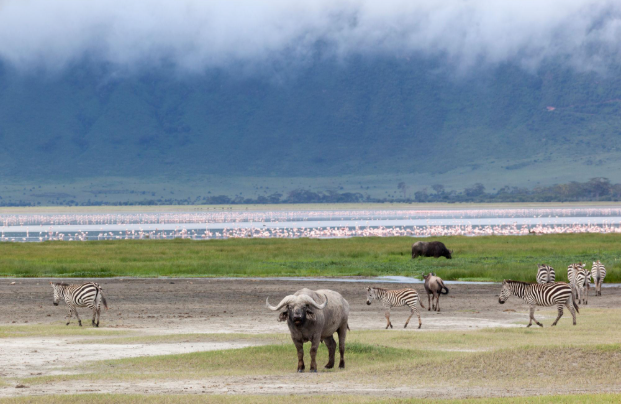
African buffalo may be seen grazing or resting in groups.
Their dark faces, curved horns, and powerful appearance make dramatic photographic subjects.
Close portraits can work well, while wider compositions can show herds within the Lake Manyara landscape.
Zebras create beautiful patterns in wildlife photographs.
Groups of zebras can provide opportunities for compositions focusing on repetition, stripes, symmetry, interaction, and contrast.
Hippos can often be observed around wetland environments.
Photography opportunities may include hippos resting in water, opening their mouths, interacting with each other, or emerging from wetlands.
A telephoto lens is particularly useful for photographing hippos safely from a distance.
Lions may occasionally be encountered in Lake Manyara National Park.
The park historically became famous for reports of lions resting or climbing in trees.
Wildlife behavior is never guaranteed, but encountering lions in wooded environments can create distinctive photographs compared with the open plains of Serengeti.
Lake Manyara is an excellent destination for bird enthusiasts and wildlife photographers.
The combination of lake, forest, woodland, marshes, and grassland supports a remarkable variety of birdlife.
Depending on season and conditions, photographers may encounter species such as:
Bird photography requires patience.
Your guide can help identify areas where birds are active and position the safari vehicle without disturbing them.
A telephoto lens around 300mm or longer can be especially useful for bird photography.
Flamingos are among the most famous photographic subjects associated with Lake Manyara.
However, flamingo numbers can change substantially according to water levels, food availability, rainfall, and seasonal conditions.
When large concentrations are present, they can create beautiful pink patterns against the lake.
Photographers should remember that wildlife sightings and flamingo concentrations cannot be guaranteed on a particular safari date.
This is one reason why working with an experienced local safari guide is valuable.
Lake Manyara is not only about wildlife.
Landscape photographers can capture:
Including animals within wider landscapes is a powerful way of showing the environment rather than focusing only on close-up portraits.
Lake Manyara can be visited throughout much of the year, but different seasons provide different photographic advantages.
This period generally falls within Tanzania’s dry season.
Vegetation becomes less dense in many places, which can make wildlife easier to locate and photograph.
Conditions may also provide:
The dry season is popular with safari travelers, so advance booking is recommended.
This period can produce greener landscapes and dramatic skies.
Photography advantages include:
Short rains may occur during part of this period, but showers can create impressive photographic conditions.
These months are usually associated with heavier rainfall in northern Tanzania.
The scenery can become exceptionally green.
Photographers interested in dramatic landscapes, fewer vehicles, and atmospheric conditions may enjoy this period.
However, rain can sometimes affect road conditions and safari schedules.
Early morning is one of the best times for wildlife photography.
The light is often softer and warmer than during the middle of the day.
Advantages of morning photography include:
Starting early can make a major difference to the photographic quality of your safari.
Late afternoon also provides excellent photography opportunities.
As the sun becomes lower, the light becomes warmer and softer.
This can be particularly useful for photographing:
Photographers should communicate their preferred lighting style to the guide.
The safari vehicle plays an important role in wildlife photography.
A typical photography safari uses a 4x4 Land Cruiser with a pop-up roof, allowing travelers to stand and photograph wildlife comfortably.
The elevated roof provides better visibility while maintaining a safe wildlife-viewing environment.
Depending on the safari setup, vehicles may also provide charging facilities for cameras, phones, and other equipment.
A private safari is particularly valuable for serious photographers because you can spend more time at individual sightings.
A private photography safari gives you significantly more flexibility than a standard group safari.
You can decide:
For serious wildlife photographers, this flexibility can dramatically improve the experience.
You do not need professional equipment to enjoy a Lake Manyara photography safari.
However, bringing appropriate equipment can help you capture a wider variety of images.
Consider carrying:
A 70–200mm lens is useful for medium-distance animals and environmental portraits.
It is particularly effective for:
A lens in this range is highly versatile for African safaris.
It allows photographers to capture both medium-distance subjects and tighter wildlife portraits.
Longer lenses can be useful for:
However, longer lenses are heavier and may benefit from additional support.
Wide-angle lenses are valuable for:
Wildlife can move quickly, so camera settings should be adjusted according to the subject.
For moving animals, photographers often use faster shutter speeds.
For example, approximately 1/1000 second or faster may help freeze action, while slower speeds can be used intentionally for motion effects.
Continuous autofocus and burst shooting can help capture unpredictable behavior.
Always monitor exposure carefully because bright sky, dark animals, and reflective water can create challenging conditions.
Bird photography can be challenging but rewarding.
Useful techniques include:
Patience is essential.
Watching a bird's behavior before photographing can help you anticipate when it may take off.
Responsible wildlife photography is extremely important.
Photographers should never pressure guides to disturb animals simply to obtain a better photograph.
Responsible safari photography includes:
The welfare of the animal should always come before the photograph.
Arrive in Arusha, the main gateway to Tanzania’s Northern Safari Circuit.
Depending on your arrival time, you can relax at your accommodation and prepare your camera equipment for the safari.
Your safari guide may provide a pre-safari briefing covering:
Overnight in Arusha.
After breakfast, travel from Arusha toward Lake Manyara National Park.
The drive takes you through beautiful northern Tanzanian landscapes.
Upon entering Lake Manyara, begin your photography-focused game drive.
Your guide will search for elephants, giraffes, zebras, baboons, monkeys, buffalo, birds, and other wildlife.
Instead of rushing between sightings, a photography safari allows additional time to observe behavior and wait for better compositions.
Enjoy lunch before continuing your afternoon game drive.
During the later part of the day, look for warm light over the landscape.
Overnight near Lake Manyara, Mto wa Mbu, or Karatu depending on the itinerary.
Start early for another opportunity to photograph Lake Manyara wildlife in soft morning light.
Concentrate on subjects that were missed during the previous game drive.
This may include:
After completing the safari, return toward Arusha or continue to another Tanzania national park.
A Lake Manyara photography vacation becomes even more rewarding when combined with other destinations.
Tarangire National Park is particularly famous for elephants, baobab trees, and dramatic dry-season wildlife concentrations.
Combining Tarangire and Lake Manyara gives photographers contrasting landscapes.
Lake Manyara provides forests, wetlands, and Rift Valley scenery, while Tarangire offers open woodland, baobabs, river environments, and larger landscapes.
Ngorongoro Crater provides another very different photographic environment.
The crater floor supports a high concentration of wildlife and can provide opportunities to photograph:
Combining Lake Manyara and Ngorongoro provides excellent diversity within a relatively short safari.
For travelers with more time, combining Lake Manyara with Serengeti National Park provides one of Tanzania’s finest wildlife photography experiences.
The Serengeti is famous for:
Lake Manyara adds forest, wetlands, birdlife, and Rift Valley scenery to the itinerary.
A complete Northern Circuit photography safari can include:
Day 1: Arrival in Arusha
Day 2: Lake Manyara National Park
Day 3: Serengeti National Park
Day 4: Serengeti photography safari
Day 5: Serengeti to Ngorongoro
Day 6: Ngorongoro Crater
Day 7: Return to Arusha
Longer itineraries allow photographers to spend additional time in Serengeti and improve opportunities for animal behavior photography.
A Photography Lake Manyara Safari Vacation can be organized at several comfort levels.
Budget options may include campsites or simple accommodations.
This is suitable for travelers who want to prioritize wildlife experiences while controlling safari costs.
Mid-range lodges and tented camps generally provide comfortable rooms, private bathrooms, restaurant facilities, and convenient locations.
This category provides an excellent balance between comfort and price.
Luxury accommodations may include premium lodges with:
Luxury safaris can also include private vehicles and personalized schedules.
You do not need professional experience to join a photography safari.
Beginners can enjoy the safari while learning how to:
Even smartphone users can capture excellent photographs when lighting and composition are good.
Professional photographers may require additional arrangements.
These can include:
Photographers producing commercial content should also verify any applicable filming, drone, or professional photography permissions before traveling.
Recommended safari clothing includes:
For photography equipment, consider:
Safari roads can become dusty, particularly during dry conditions.
To protect your equipment:
Using two camera bodies can reduce the need to change lenses during wildlife sightings.
Most wildlife photography in Tanzania is conducted from inside the safari vehicle.
Photographers should avoid excessive movement when other travelers are trying to photograph the same subject.
On private photography safaris, your guide can reposition the vehicle when permitted to obtain better angles.
Always follow national park rules.
Lake Manyara can be included in romantic or honeymoon safari itineraries.
Couples can combine wildlife photography with:
A private safari allows couples to enjoy a more relaxed pace.
Families can also enjoy Lake Manyara.
The variety of animals and relatively compact safari environment can make it interesting for younger travelers.
Children may particularly enjoy photographing elephants, monkeys, giraffes, zebras, and colorful birds.
Arusha is one of the most convenient starting points for Lake Manyara safaris.
Travelers can stay overnight in Arusha and depart the following morning.
The park can be incorporated into a one-day safari, although photographers usually benefit from combining it with an overnight stay or a longer Northern Circuit itinerary.
Travelers staying in Zanzibar can combine a beach holiday with a photography safari.
A typical itinerary may include:
Zanzibar → flight to northern Tanzania → Lake Manyara safari → Ngorongoro or Serengeti → return flight to Zanzibar.
This creates an excellent combination of wildlife photography and beach relaxation.
A standard visitor may spend one game drive in the park.
Photography-focused travelers may prefer more time.
One full day allows you to photograph several habitats, while additional time increases the chance of observing different lighting conditions and animal behavior.
For a complete Tanzania photography safari, we normally recommend combining Lake Manyara with at least two additional destinations.
Lake Manyara is different from Serengeti and Ngorongoro because of its compact but highly varied environment.
Within a short distance you may move from dense forest to wetlands, grassland, and lakeshore environments.
This creates very different photographic backgrounds.
Rather than producing an entire portfolio of open savannah images, photographers can capture wildlife surrounded by vegetation, water, forest, and dramatic escarpment scenery.
Yes.
Lake Manyara is particularly good for:
It is especially useful as part of a broader Northern Circuit photography safari.
For travelers who enjoy photography, choosing a safari designed around photography is often worthwhile.
Standard game drives normally focus on seeing as many animals as possible.
Photography safaris place greater emphasis on:
Waiting five or ten additional minutes at a sighting can sometimes produce a completely different photograph.
We design Tanzania safari vacations according to each traveler’s interests.
For photography-focused travelers, we can arrange:
Our goal is to provide enough flexibility for travelers to enjoy wildlife rather than rushing through the itinerary.
Depending on the selected safari package, inclusions may cover:
Exact inclusions should always be confirmed in your personalized safari quotation.
Depending on your package, exclusions may include:
A Photography Lake Manyara Safari Vacation offers far more than simply taking photographs of animals.
It is an opportunity to observe wildlife carefully, understand animal behavior, explore diverse ecosystems, and capture meaningful images of Tanzania’s natural environment.
Photograph elephants beneath forest trees, giraffes against the Great Rift Valley, colorful birds along the wetlands, monkeys in the forest canopy, and dramatic landscapes surrounding Lake Manyara.
Whether you are planning a dedicated photography trip or adding Lake Manyara to a Serengeti and Ngorongoro safari, we can customize the experience according to your travel dates, budget, accommodation preference, photography interests, and preferred safari duration.
Contact Kilipath African Safaris to start planning your Photography Lake Manyara Safari Vacation and create a personalized Tanzania safari itinerary designed around the photographs and wildlife experiences you want to capture.
A Lake Manyara safari can cost USD 150–220 per person for a shared day trip from Arusha. A published example of a…
Read articlePlanning a Tanzania safari that combines Lake Manyara National Park and Nyerere National Park is an excellent way to experience the country's…
Read articlePlanning an unforgettable African wildlife adventure from Zanzibar? Understanding the Tanzania safari package Zanzibar price is an important first step toward choosing…
Read articlePlanning an African wildlife adventure? Understanding the group Tanzania safari price is an important step toward choosing an affordable and unforgettable safari…
Read article