

Budget Ngorongoro Crater Safari Holiday
Planning a budget Ngorongoro Crater safari holiday from Arusha? Compare a crater day trip, a two-day Tarangire and Ngorongoro safari, or a…
Read articleArusha City - Tanzania
Safari & Travel Tips
September 3, 2026 · 18 min read
A photography Serengeti safari cost can range from approximately $300 to more than $1,500 per person per day, depending on the season, accommodation category, number of travelers, safari duration, vehicle arrangement, and whether the trip has been designed specifically for wildlife photography.
For serious photographers, cost should not be judged only by the quality of the lodge. The most important investment is often a private safari vehicle with a knowledgeable guide, because photography requires patience, positioning, flexibility, and enough space for cameras and long lenses.
Across Tanzania, current 2026 safari market estimates commonly place budget trips around $250–$400 per person per day, mid-range trips around $400–$800, and luxury experiences from roughly $800 to $1,500+ per person per day. Exact prices vary significantly according to inclusions and season.
For photographers interested in lions, leopards, cheetahs, elephants, the Great Migration, dramatic landscapes, and African birdlife, the Serengeti remains one of Tanzania's outstanding photographic destinations.
A useful planning estimate is:
| Safari Style | Estimated Cost Per Person/Day | Suitable For |
|---|---|---|
| Budget/shared safari | $250–$400 | Beginners and travelers prioritizing price |
| Private budget photography safari | $350–$550 | Enthusiast photographers |
| Private mid-range safari | $500–$800 | Most wildlife photographers |
| Luxury photography safari | $800–$1,300 | Serious photographers seeking comfort |
| Premium/luxury migration safari | $1,200–$1,500+ | Professionals and specialist trips |
These figures are planning ranges rather than fixed package prices. Accommodation availability, group size and the specific Serengeti region can change the final quotation substantially. Current published 2026 estimates show similarly wide differences between budget, mid-range and luxury Serengeti travel.
A private photographic safari will generally cost more than a conventional shared safari, but photographers gain much greater control over when to stop, how long to remain at a sighting and where to position the vehicle.
A normal safari and a photography-focused safari can visit exactly the same park, yet their costs may differ.
That is because photographers usually require a different style of operation.
A private 4x4 is one of the most important elements of a Serengeti photographic safari.
Instead of sharing the vehicle with several travelers who have different priorities, you decide how your game drives operate.
You might spend 45 minutes watching a leopard instead of moving on after five minutes.
You can wait for a lion to move into good light.
You can follow a cheetah when its behavior suggests it may hunt.
You can remain beside elephants until they approach a water source.
Those opportunities are difficult to guarantee on a regular shared departure.
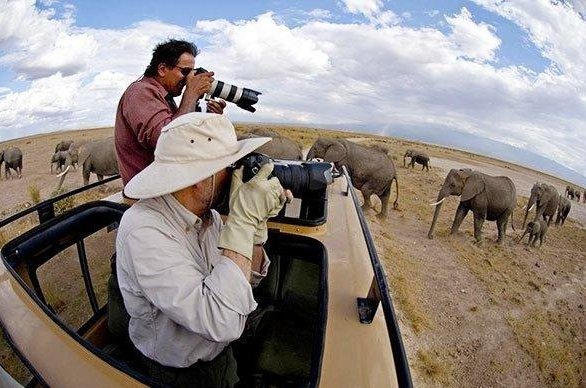
Photography requires space.
Professional camera bodies, 400mm or 600mm lenses, bean bags, batteries and backpacks take up considerable room.
A typical safari vehicle may technically accommodate several passengers, but a serious photographic setup is more comfortable with fewer photographers.
Two photographers sharing a private vehicle can have enormous freedom.
Four may still work very well.
Using every passenger seat dramatically reduces maneuverability when animals suddenly change position.
Guiding is particularly important when evaluating photography Serengeti safari cost.
A photographer needs more than someone who can identify an animal.
A strong photographic safari guide understands:
Sometimes moving the vehicle only five meters changes a photograph completely.
Most well-designed Serengeti safari packages include several major expenses.
These typically include:
Photographers should always ask whether there are any additional accommodation-related conservation, camping or concession fees.
Tanzania National Parks maintains official park tariffs, and TANAPA notes that conservation fees operate on a 24-hour entry basis.
Park charges make up an important portion of any Serengeti safari budget.
Unlike accommodation, national park charges cannot simply be removed when trying to create a cheaper itinerary.
The exact payable amount can vary according to visitor classification, vehicle arrangements, accommodation type and current government tariffs.
TANAPA publishes official park fees and notes that government taxes such as VAT apply where relevant. Because tariffs can change, travelers should always use the current quotation rather than relying on an old blog post or safari price found online.
This is particularly important when comparing safari companies.
One operator may advertise a low headline price but quote some government charges separately.
Another might offer a more expensive-looking package that already includes virtually everything.
Always compare the final total price, not merely the advertised daily rate.
A private safari is preferable for dedicated photographers.
You decide:
For serious wildlife photographers, this flexibility can provide substantially better value than simply booking a more expensive hotel.
For photography, usually yes.
Imagine finding a leopard lying on a tree branch.
A conventional safari vehicle might photograph it for ten minutes and continue.
A photographer may notice that the leopard is becoming alert.
Waiting another 40 minutes could result in the animal climbing down, walking through golden grass and perhaps interacting with another leopard.
Those moments are what wildlife photographers travel across continents to capture.
A private vehicle gives you the ability to wait.
A three-day safari is possible but relatively short.
Approximate range:
$1,000–$2,400+ per person
depending on:
It can work well for travelers with limited holiday time.
However, serious photographers should consider staying longer.
Approximate range:
$1,400–$3,200+ per person
Four days provides much better photographic potential.
You can dedicate more time to Central Serengeti instead of feeling pressured to constantly move between locations.
Approximate range:
$1,750–$4,000+ per person
Five days is an excellent starting point for wildlife enthusiasts.
It gives photographers enough time to experience changing light and revisit productive wildlife territories.
Published 2026 market pricing for general five-day Serengeti trips varies widely according to safari category, reinforcing how strongly accommodation and travel style affect the final total.
Approximate range:
$2,500–$6,000+ per person
Seven days gives serious photographers considerably more flexibility.
You could combine:
For migration photography, a longer safari greatly improves your chances of experiencing different wildlife behavior.
Approximate range:
$4,000–$10,000+ per person
A longer itinerary works particularly well for:
Instead of rushing between destinations, the safari can be designed around photographic opportunities.
The Serengeti is enormous.
Trying to photograph the entire ecosystem during a short trip is usually not the best approach.
Choose areas according to season and subject.
Central Serengeti is one of the most reliable year-round wildlife photography areas.
It is particularly famous for predators.
Potential subjects include:
The Seronera River system supports wildlife throughout much of the year.
Central Serengeti is therefore excellent for first-time photographers.
Northern Serengeti becomes especially popular from approximately July through October when migratory herds move through the region.
The biggest photographic attraction is the possibility of Mara River crossings.
A river crossing can produce dramatic photographs of:
But crossings cannot be scheduled.
You may wait for hours while wildebeest gather beside the river and then watch them move away without crossing.
That is normal wildlife behavior.
This is why patience is essential.
From roughly December through March/April, the southern Serengeti ecosystem and Ndutu area become extremely attractive for photographers.
The migration gathers on the short-grass plains.
February is famous for calving.
Photographic possibilities include:
For photographers interested in predator-prey behavior, this period can be extraordinary.
The Western Corridor becomes particularly interesting during the movement of the migration toward the north.
The landscape differs significantly from Central Serengeti.
It offers rivers, woodland, open plains and different photographic backgrounds.
Fewer visitors in some areas can also create a more relaxed photography experience.
There is no single best month.
It depends on what you want to photograph.
| Period | Photography Highlights |
|---|---|
| January–March | Calving, predators, green plains |
| April–May | Dramatic skies, fewer vehicles, lush scenery |
| June | Migration movement and dry-season transition |
| July–October | Northern migration and possible river crossings |
| November | Short rains, fresh landscapes |
| December | Southern migration, green season begins |
For photographers, each season produces a different visual style.
The dry season generally provides:
It is also high season.
That can mean:
Booking early is particularly important for Northern Serengeti during peak migration months.
The green season can be exceptional for photography.
Advantages include:
Many photographers actually prefer these months because images can look more atmospheric than conventional dry-season safari photographs.
Accommodation pricing changes substantially according to season.
During peak months, desirable camps can fill well in advance.
A camp that is relatively affordable during low season may become considerably more expensive during:
Traveling during shoulder months is one of the easiest ways of reducing your photography Serengeti safari cost without compromising wildlife quality.
Budget camping provides the cheapest option.
Expect:
For photographers, budget camping can actually make sense because it allows more money to be invested in additional safari days or a private vehicle.
For many photographers, mid-range tented camps offer the best balance.
They generally provide:
The saving compared with luxury properties can be used to extend your safari.
And in wildlife photography, an extra three days in the field may produce more value than upgrading a room.
Luxury camps can provide:
Costs rise considerably, particularly during high season.
Luxury makes sense if comfort is an important part of your overall experience, but it is not essential for getting outstanding photographs.
Flying directly into the Serengeti can significantly reduce travel time.
Flights commonly connect Serengeti airstrips with areas such as:
A fly-in safari usually costs more than driving but gives photographers additional time inside the park.
This can be particularly useful for:
Advantages:
Best for travelers with enough time.
Advantages:
The disadvantage is higher price and potentially stricter luggage limits.
Your vehicle can have more impact on your photography than your lodge.
An appropriate Serengeti photography vehicle should ideally offer:
A conventional safari Land Cruiser works very well when passenger numbers are controlled.
Photography changes quickly.
A lion might appear to your left.
A cheetah can suddenly move behind the vehicle.
Elephants may cross the road.
You need room to reposition.
For serious photography, everyone having good window access is more valuable than maximizing the number of passengers.
You do not need professional equipment to enjoy photographing the Serengeti.
But appropriate lenses help enormously.
DSLR and mirrorless cameras are both excellent.
If possible, carry two camera bodies.
For example:
This reduces lens changes in dusty conditions.
A versatile setup could include:
24–70mm
Excellent for landscapes, people, vehicles and elephants nearby.
70–200mm
Useful for larger animals and environmental portraits.
100–400mm / 100–500mm
Probably one of the most practical safari lens ranges.
200–600mm
Excellent for birds and distant wildlife.
400mm / 500mm / 600mm primes
Outstanding for specialist wildlife photographers but heavier and more expensive.
Not necessarily.
Animals sometimes approach safari vehicles surprisingly closely.
For lions, elephants, giraffes and large mammals, a 100–400mm or 100–500mm lens can be extremely versatile.
A 500mm or 600mm lens becomes particularly helpful for:
A bean bag is an excellent safari accessory.
It can be positioned on:
This provides stability without requiring a full tripod.
Tripods can be awkward inside vehicles, although specialist photographic vehicles may offer mounting systems.
Ask your operator about charging before departure.
Long game drives consume batteries quickly, especially when using:
Carry spare batteries.
A photographer might easily use two or three batteries during an intensive day.
The Serengeti creates a serious data problem—the good kind.
A single productive encounter can produce thousands of images.
Bring:
Never depend on a single memory card for an entire safari.
The Great Migration is one of the world's most famous wildlife events.
But photographers should understand that the migration is dynamic.
Animals respond to:
No safari company can guarantee the exact location of every herd months in advance.
Experienced operators plan itineraries around historical migration patterns and current wildlife information.
A dedicated migration safari often costs more because it may require:
Budget approximately:
$500–$1,500+ per person per day for private mid-range through luxury migration-focused arrangements.
Northern Serengeti during river-crossing season can be particularly expensive.
No.
Anyone guaranteeing a particular crossing at a particular time is making a promise that wildlife cannot honor.
Some visitors see several crossings.
Others wait for days without seeing one.
The best strategy is spending multiple nights near the migration and allowing plenty of field time.
Some specialized departures are hosted by professional wildlife photographers.
These may include instruction on:
Such safaris cost more because you are paying for both safari operations and professional photography instruction.
For beginners or photographers developing their portfolios, this can be worthwhile.
Solo travelers normally pay more per person.
Why?
Because one traveler must cover most of the vehicle and guiding costs.
With two or four travelers, those fixed expenses are shared.
For solo photographers trying to reduce costs, possible solutions include:
Two photographers sharing a private vehicle is one of the best configurations.
Both guests can have excellent shooting positions while vehicle expenses are divided.
For couples who both enjoy photography, it is especially practical.
Four photographers can reduce the cost substantially.
However, verify vehicle seating before booking.
A vehicle that is perfectly comfortable for six general safari travelers may feel crowded when four people have:
You do not need to sacrifice photographic quality.
Consider months outside the busiest migration periods.
Wildlife remains excellent while accommodation may cost less.
A comfortable tented camp can provide everything a photographer needs.
Moving camps every day wastes valuable photographic time.
Sharing a vehicle with people who have the same priorities can substantially reduce costs.
Overland travel generally costs less.
Early booking provides better accommodation choice, particularly during migration season.
If your budget is limited, prioritize in this order:
A modest lodge combined with an excellent guide and six full photography days will often produce better images than a spectacular luxury lodge combined with rushed game drives.
Drive toward Serengeti through northern Tanzania.
Enter the park and begin photographing wildlife during the afternoon light.
Overnight Central Serengeti.
Early morning departure.
Focus on predators and golden-hour photography.
Return to camp for lunch or stay in the field with a packed lunch.
Afternoon game drive.
Full photography day.
Search different territories based on recent sightings.
Possible subjects include lions, leopards, cheetahs, elephants and hyenas.
Another unrestricted photography day.
Spend longer at productive sightings instead of constantly covering distance.
Explore another Serengeti sector or continue photographing Central Serengeti depending on wildlife activity.
Final Serengeti sunrise game drive.
Continue toward Ngorongoro.
Photograph landscapes en route.
Early descent.
Possible subjects include:
Return to Arusha in the afternoon.
Depending on operator, the following may be separate:
Always request a written list of inclusions and exclusions.
A Serengeti balloon safari provides completely different photographic possibilities.
Instead of eye-level animal portraits, you can photograph:
However, balloon baskets have limited space.
Changing lenses can also be inconvenient.
Use a versatile zoom whenever possible.
Yes, especially for first-time visitors.
Ngorongoro Crater offers a different photographic environment.
The crater walls create spectacular backgrounds, while wildlife is concentrated into a relatively compact area.
Serengeti offers scale and wilderness.
Ngorongoro provides concentration and dramatic geography.
Together they create a powerful photographic combination.
Morning light is soft and wildlife often remains active before temperatures rise.
Predators may still be hunting.
Mist, dust and backlighting can create exceptional images.
Late-afternoon light can transform ordinary scenes.
Golden grass becomes luminous.
Backlit dust becomes dramatic.
Animals often become more active again.
A lion portrait is beautiful.
But a lion interacting with cubs tells a story.
Look for:
Behavior creates stronger photographs.
The Serengeti is more than wildlife portraits.
Use wide lenses for:
Sometimes a giraffe occupying only 5% of the frame produces a stronger Serengeti photograph than a tight portrait.
Photography should never come before animal welfare.
A responsible guide should not:
The best photographs usually come from understanding natural behavior—not disrupting it.
For casual photography:
3–4 days can work.
For enthusiasts:
5–7 days is better.
For dedicated photographers:
7–10+ days is ideal.
Wildlife photography depends heavily on chance.
More days create more opportunities.
You cannot control when a leopard climbs a tree or a cheetah begins a hunt.
Time is your greatest advantage.
Absolutely.
The Serengeti provides subjects at every skill level.
Beginners can practice:
And unlike photographing wildlife at home, you often have repeated opportunities to practice throughout the day.
Settings vary according to conditions, but common starting points include:
For birds in flight, even faster shutter speeds may help.
The Serengeti can be extremely dusty during the dry season.
Useful precautions include:
Neutral colors work well:
Bring layers.
Morning game drives can feel cold, while afternoons may become warm.
A hat, sunscreen and sunglasses are valuable.
A properly operated safari is generally very safe when park rules and guide instructions are followed.
Wildlife is unpredictable, however.
Guests should:
Professional guides understand animal behavior and local conditions.
A Serengeti photography safari is not simply about taking pictures.
It gives you time to observe behavior.
You might watch a lioness teaching cubs how to approach prey.
You could wait quietly beneath a leopard resting in an acacia tree.
You may photograph thousands of wildebeest moving beneath a stormy sky.
You could spend an entire sunrise photographing one elephant family crossing the plains.
That is why photography Serengeti safari cost should be evaluated differently from the price of an ordinary sightseeing trip.
For photographers, the most valuable ingredients are time, flexibility, an experienced guide, a well-positioned vehicle and the right location for the season.
Planning a budget Ngorongoro Crater safari holiday from Arusha? Compare a crater day trip, a two-day Tarangire and Ngorongoro safari, or a…
Read articleA Tanzania safari from Zanzibar can mean a short mainland trip during your beach holiday or a complete package with flights, game…
Read articleLooking for a group Tanzania safari price from Kilipath African Safaris? A published example for our four-day shared camping safari through Tarangire,…
Read articlePair game drives on Tanzania’s mainland with a few days on Zanzibar’s coast. With Kilipath African Safaris, you can start in Arusha…
Read article

