

Budget Ngorongoro Crater Safari Holiday
Planning a budget Ngorongoro Crater safari holiday from Arusha? Compare a crater day trip, a two-day Tarangire and Ngorongoro safari, or a…
Read articleArusha City - Tanzania
Safari & Travel Tips
September 5, 2026 · 15 min read
An exclusive Tanzania safari tour itinerary is designed for travelers who want more than a standard wildlife holiday. It combines private game drives, carefully selected lodges or luxury tented camps, personalized service, flexible schedules, and extended time in some of Tanzania’s most famous wildlife destinations.
From the elephant-filled landscapes of Tarangire National Park to the endless plains of the Serengeti and the wildlife-rich floor of the Ngorongoro Crater, this itinerary gives you the freedom to experience Tanzania at your own pace.
At Kilipath African Safaris, an exclusive safari can be customized around your preferred travel dates, accommodation level, interests, group size, and budget. Whether you are planning a honeymoon, anniversary trip, family safari, photography journey, or once-in-a-lifetime African adventure, your safari can be designed specifically around you.
The biggest difference between an exclusive safari and a standard safari is flexibility.
On a private safari, your vehicle and professional safari guide are dedicated to your group. Instead of following a rigid timetable, you can decide how your day should unfold.
If you find a pride of lions early in the morning, for example, you can spend additional time watching their behavior instead of leaving because other travelers in the vehicle want to move on.
If you are passionate about photography, your guide can position the vehicle carefully and wait for better light or animal behavior.
If you prefer a relaxed safari, you can start later, enjoy longer lunches, or return to your lodge earlier.
An exclusive Tanzania safari is therefore particularly suitable for:
The goal is not simply to visit Tanzania's parks. It is to experience them in a way that matches your personal travel style.
One of the most rewarding Northern Tanzania itineraries combines:
Arusha → Tarangire → Serengeti → Ngorongoro → Arusha
This route provides an excellent balance between landscapes, wildlife viewing and travel time.
Your exclusive safari begins when you arrive in Tanzania.
Depending on your international flight, you will normally arrive at Kilimanjaro International Airport (JRO) or Arusha Airport after connecting from another Tanzanian destination.
A representative can meet you at the airport and transfer you privately to your accommodation in Arusha.
Rather than starting a long game drive immediately after an international flight, spending your first night in Arusha allows you to relax and prepare for the adventure ahead.
You can enjoy the hotel garden, swimming pool or restaurant while your safari guide briefs you about the upcoming journey.
Arusha hotel or lodge according to your chosen accommodation category.
Guests arriving early can add experiences such as:
The evening is also a good opportunity to check your camera equipment, prepare safari clothing and pack a smaller bag for the journey.
After breakfast, your private safari guide will meet you at your accommodation.
You will travel south-west toward Tarangire National Park, one of Tanzania's most distinctive wildlife destinations.
Tarangire is particularly famous for its large elephant population and magnificent baobab trees. TANAPA describes the park as especially notable for elephants, while seasonal wildlife movements bring wildebeest, zebra and other herbivores toward the Tarangire River during drier periods.
The landscape immediately gives your safari a classic African feeling.
Huge baobab trees rise above golden grasslands while elephants often move between woodland areas and the river.
During your game drive, look for:
Tarangire is also an excellent destination for birdwatching.
Your guide will choose game-drive routes according to recent wildlife movements rather than simply following a fixed road.
This is one advantage of having a knowledgeable private guide.
Depending on the itinerary, lunch may be served at a picnic area or arranged as part of a more exclusive bush experience.
After further afternoon wildlife viewing, you continue to your lodge or tented camp.
Luxury or mid-range lodge near Tarangire, Karatu or inside the safari circuit.
After breakfast, your journey continues toward one of Africa's legendary wildlife destinations:
The drive itself is part of the safari experience.
You travel through changing landscapes toward the vast Serengeti ecosystem.
Eventually the terrain opens into enormous grasslands stretching toward the horizon.
This is where the meaning of the Serengeti becomes visible: vast open country filled with wildlife.
Serengeti National Park is internationally famous for exceptional wildlife viewing and the annual Great Migration. Official TANAPA material identifies the Great Migration, Big Five, large concentrations of carnivores and herbivores, rare species and dramatic landscapes among the park's major attractions.
After entering the Serengeti, you begin a game drive while traveling toward your camp.
Wildlife can appear almost anywhere.
A seemingly empty grassland may suddenly reveal:
Your guide will constantly scan the landscape for movement.
Luxury tented camp or safari lodge in Serengeti.
Today is dedicated entirely to wildlife exploration.
A full day in Serengeti is one of the highlights of an exclusive Tanzania safari tour itinerary.
Because your vehicle is private, you are not restricted by the preferences of unrelated travelers.
If you are serious about wildlife photography, an early departure is recommended.
Predators can be especially active during the cooler hours around sunrise.
Your guide may pack breakfast so you can begin exploring before returning to camp, or your lodge can arrange an early breakfast depending on your preference.
Serengeti is particularly famous for predators.
Possible sightings include:
Large prides inhabit many parts of the ecosystem.
You may see lions:
Open grasslands provide ideal habitat for cheetahs.
Watching a cheetah scan the plains from a termite mound is a classic Serengeti experience.
Leopards are more elusive.
Your guide may search riverine forests and large trees where these cats sometimes rest.
Spotted hyenas play an important role in the Serengeti ecosystem and can frequently be encountered around areas with high concentrations of prey.
For many travelers, the Great Migration is the main reason for booking Tanzania.
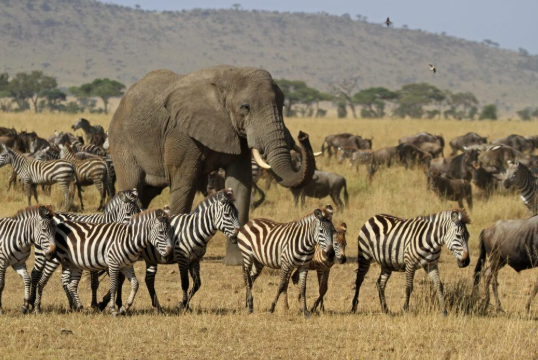
More than a simple single event, the migration is a continuous movement through the greater Serengeti ecosystem as wildebeest and other grazing animals follow food and water availability.
Official TANAPA information describes a migration involving more than 1.5 million wildebeest together with vast numbers of zebras, gazelles and other herbivores.
However, the animals do not remain in one location throughout the year.
Your itinerary should therefore be matched carefully with your travel period.
The southern Serengeti and Ndutu region can become particularly important.
This is associated with the calving season.
Travelers often visit this region hoping to see large herds, newborn animals and increased predator activity.
The herds gradually move through different parts of the ecosystem as seasonal conditions change.
Movement generally progresses toward the western and central areas.
Northern Serengeti becomes particularly important.
This is the period most associated with potential Mara River crossing activity.
However, wildlife is wild.
No safari company can guarantee that a river crossing will happen on a particular day or at a particular location.
A well-planned exclusive safari improves your chances by placing you in the appropriate region and allowing your guide greater flexibility.
For an additional experience, consider adding a hot-air balloon safari.
You normally wake before sunrise and transfer to the launch area.
After a safety briefing, the balloon rises above the landscape as daylight spreads across the Serengeti.
Depending on the route and conditions, you may see wildlife, rivers, plains and acacia woodland from above.
The experience is particularly popular with:
Because balloon spaces can be limited, advance reservation is recommended.
A common mistake when planning a Tanzania safari is trying to visit too many places too quickly.
Spending another day in Serengeti gives you time to explore instead of constantly moving between parks.
Wildlife viewing cannot be scheduled like visiting a museum.
Animals move.
Weather changes.
Predators may disappear into tall grass.
Migration herds can change direction.
Therefore, additional time significantly improves the quality of the safari.
Your guide may choose a different part of the park depending on recent sightings.
For example, today's game drive may focus on river systems, woodland habitat or open plains rather than repeating yesterday's route.
05:30–06:00 – Wake up and prepare.
Around sunrise – Begin morning game drive.
Morning – Search for predators and active wildlife.
Late morning – Continue exploring.
Lunch – Picnic lunch or return to camp.
Afternoon – Second game drive.
Sunset – Return to camp.
However, these times remain flexible on a private safari.
If you prefer to spend the entire day inside the wilderness, a packed lunch can allow you to remain out longer.
Enjoy your final Serengeti game drive while traveling toward the Ngorongoro highlands.
The landscape gradually changes again.
Eventually, you ascend toward the Ngorongoro Conservation Area.
The Ngorongoro Conservation Area is not only a wildlife destination but also an area of exceptional geological, ecological and cultural significance.
The Ngorongoro Conservation Area Authority highlights attractions including Ngorongoro Crater, Olduvai Gorge, Ndutu Plains, Empakaai Crater and other geological and archaeological sites.
Depending on your program, you may stop at a viewpoint overlooking the crater.
The scale is impressive.
From the rim, the crater floor appears like an enormous natural amphitheater.
Travelers interested in archaeology and human history can add a visit to Olduvai Gorge.
This stop is particularly suitable for guests who want their safari to include more than wildlife.
Luxury lodge around Ngorongoro or Karatu.
For a particularly exclusive experience, accommodation on or near the crater rim can provide spectacular views, although these properties are generally more expensive.
Your final major wildlife experience is a game drive inside Ngorongoro Crater.
An early departure is recommended.
After arriving at the descent road, your safari vehicle travels down through the highland vegetation toward the crater floor.
Ngorongoro Crater contains an extraordinary variety of wildlife.
The official Ngorongoro Conservation Area Authority lists animals including elephants, buffalo, lions, black rhinos, hippos, hyenas, wildebeest, zebras, gazelles and other species within the broader conservation area and crater ecosystem.
Unlike Serengeti's seemingly limitless plains, Ngorongoro offers wildlife viewing within an enormous volcanic landscape.
The crater includes:
These different habitats support an impressive variety of wildlife.
You may encounter herds of buffalo and wildebeest while hyenas patrol nearby.
Lions may rest close to game-drive tracks.
Hippos can often be observed around wetland areas.
The endangered black rhinoceros is also present, although sightings can never be guaranteed.
NCAA describes Ngorongoro as an important location for Big Five wildlife and particularly valuable for observing the area's concentrated wildlife populations.
After several hours exploring the crater floor, you ascend the crater wall.
You then begin the journey back toward Arusha.
Depending on your onward travel arrangements, you can:
An exclusive safari is not simply about choosing an expensive lodge.
The real luxury is often time, privacy and flexibility.
You travel in your own safari vehicle instead of sharing with unrelated travelers.
A typical private safari vehicle includes a pop-up roof that allows passengers to stand during wildlife viewing.
Having your own vehicle also means you control the pace.
Your guide remains with you throughout the safari.
A good guide does much more than drive.
They help interpret:
Experienced guides also communicate with other guides to learn where interesting wildlife activity may be taking place.
Private safaris allow greater control over departure times.
Want to start at 5:30 AM?
Possible.
Want to stay longer with a leopard?
Your guide can accommodate that when park regulations and logistics allow.
Want to return early because your children are tired?
You can.
This flexibility can dramatically improve the overall safari experience.
Your exclusive Tanzania safari tour itinerary can be designed at several comfort levels.
Ideal for travelers who want private facilities and comfortable accommodation while keeping costs reasonable.
Typically includes:
Luxury itineraries may include carefully selected camps in prime wildlife locations.
Possible features include:
For guests seeking the highest level of privacy and comfort, an itinerary can include premium camps, boutique lodges and fly-in connections.
Experiences may include:
The exact package should always be confirmed before booking, but an exclusive safari can include:
Additional language guides such as French, Spanish, German or Italian may also be arranged for private safaris depending on availability.
Unless specifically stated in your quotation, items commonly excluded include:
Always check your final itinerary and invoice because inclusions vary between packages.
Tanzania is a year-round safari destination, but your ideal month depends on your objectives.
Excellent for travelers interested in southern Serengeti and Ndutu during the broader calving period.
Predator activity can be fascinating because large concentrations of herbivores attract carnivores.
These months include Tanzania's wetter period.
Landscapes can become beautifully green.
Visitor numbers may be lower in some locations, although rain can affect road conditions and daily safari logistics.
This is the long dry season and one of the most popular periods for Northern Circuit safaris.
Tarangire can be particularly rewarding as wildlife concentrates around dependable water sources; TANAPA specifically notes dry-season concentrations around the Tarangire River.
July through October is also the key window for travelers interested in Northern Serengeti migration experiences.
The short rains can transform landscapes.
Wildlife remains present throughout Tanzania's major parks, and the migration begins shifting toward southern areas as seasonal conditions evolve.
Tanzania is particularly well suited for honeymoon safaris.
You can combine adventure during the day with romantic accommodation in the evening.
Possible honeymoon additions include:
A popular itinerary is:
7-day private safari + 4–6 nights in Zanzibar
This combines wildlife and beach relaxation in one journey.
After several days of game drives, Zanzibar provides a completely different atmosphere.
You can fly from Arusha or Serengeti to Zanzibar depending on your itinerary.
Spend several nights enjoying:
This combination is particularly popular among couples and honeymooners.
Private safaris can be especially useful for families.
Parents do not have to worry about disturbing unrelated travelers if children become tired or need breaks.
The schedule can be adjusted around:
Families can also choose accommodation with family rooms or interconnected rooms.
Wildlife photographers benefit enormously from private vehicles.
Photography safaris can focus on:
For serious photographers, the itinerary should include multiple nights in major wildlife areas rather than moving to a new destination every day.
Suitable for travelers with limited time.
A typical itinerary might cover:
Tarangire → Serengeti → Ngorongoro
This is fast-paced but possible.
Allows slightly more time in Serengeti.
Excellent for travelers combining safari with Zanzibar.
Provides a better balance between driving and wildlife viewing.
One of the strongest options for first-time travelers.
You have enough time to experience several ecosystems without rushing excessively.
Ideal for photographers, migration-focused trips and luxury travelers.
Additional time can be spent in:
| Day | Destination | Main Experience |
|---|---|---|
| 1 | Arusha | Arrival and safari briefing |
| 2 | Tarangire | Elephant viewing and baobab landscapes |
| 3 | Serengeti | Scenic transfer and afternoon game drive |
| 4 | Serengeti | Full-day wildlife safari |
| 5 | Serengeti | Predators, migration and photography |
| 6 | Ngorongoro | Final Serengeti drive and crater highlands |
| 7 | Ngorongoro Crater | Crater game drive and return to Arusha |
An exclusive Tanzania safari gives you opportunities to encounter an extraordinary range of species.
Potential sightings include:
Predators: lions, leopards, cheetahs, hyenas and jackals.
Large mammals: elephants, buffalo, giraffes, hippos and rhinoceros.
Grazers: wildebeest, zebras, gazelles, impalas, elands and hartebeest.
Other animals: warthogs, baboons, monkeys, mongoose and numerous smaller mammals.
Birdlife is equally impressive, particularly around wetlands, woodlands and grasslands. NCAA notes more than 550 bird species in the Ngorongoro Conservation Area.
There is no single price because several factors influence the cost.
The biggest factors are:
Private safari costs such as the vehicle and guide are divided among participants.
A safari for four people therefore usually costs less per person than the same private itinerary for one traveler.
Camping, mid-range lodges, luxury tented camps and premium properties have very different rates.
July through October and festive periods can have higher accommodation demand.
Longer itineraries include additional accommodation, park fees, meals and guide/vehicle costs.
Fly-in itineraries cost more but reduce driving time.
Balloon safaris, cultural visits and private bush experiences increase the package cost.
For this reason, the best approach is to request a customized quotation using your:
travel dates + number of people + preferred comfort level + number of safari days.
Imagine waking before sunrise in the Serengeti.
The air is cool.
Your guide prepares the safari vehicle while the first golden light spreads across the plains.
A lion begins walking through the grass.
A herd of elephants appears in the distance.
Thousands of wildebeest may stretch toward the horizon.
And because this is your exclusive Tanzania safari tour itinerary, there is no need to rush to the next stop.
You have time to watch.
Time to photograph.
Time to experience the moment.
Send us your preferred travel dates, number of travelers and desired number of safari days, and Kilipath African Safaris can prepare a personalized Tanzania safari itinerary and quotation for you.
Planning a budget Ngorongoro Crater safari holiday from Arusha? Compare a crater day trip, a two-day Tarangire and Ngorongoro safari, or a…
Read articleA Lake Manyara safari can cost USD 150–220 per person for a shared day trip from Arusha. A published example of a…
Read articleExplore Ruaha National Park’s baobab country on a guided safari built around your dates, group size and budget. Spend your game drives…
Read articleA Nyerere Tanzania wildlife safari can take you from a woodland game drive in the morning to a boat on the Rufiji…
Read article

