

Budget Ngorongoro Crater Safari Holiday
Planning a budget Ngorongoro Crater safari holiday from Arusha? Compare a crater day trip, a two-day Tarangire and Ngorongoro safari, or a…
Read articleArusha City - Tanzania
Safari & Travel Tips
September 10, 2026 · 10 min read
A safari in Tanzania's Serengeti National Park is often considered a once-in-a-lifetime journey, but visiting this famous destination does not necessarily require a luxury budget. With careful budget Serengeti safari planning, travelers can experience spectacular wildlife, beautiful savannah landscapes, and memorable game drives while keeping costs manageable.
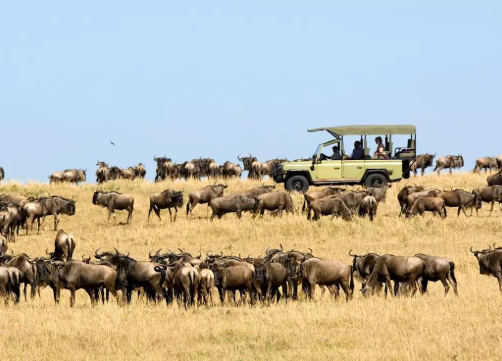
Serengeti National Park is internationally famous for its wildlife and the annual movement of wildebeest and zebra through the wider Serengeti ecosystem. The Tanzania Tourism Board highlights the annual migration as one of the park's defining attractions, while the Serengeti is also home to resident wildlife throughout the year.
The key to an affordable safari is understanding where your money goes. Park fees, transportation, accommodation, meals, guides, vehicles, and government charges all affect the final price. Rather than simply looking for the cheapest offer, travelers should compare what is actually included.
This guide explains how to organize an affordable Serengeti trip without sacrificing the essential safari experience.
The Serengeti offers something valuable for almost every type of safari traveler. Large areas of open grassland make wildlife viewing excellent, while predators such as lions, cheetahs, leopards and hyenas share the ecosystem with elephants, giraffes, buffaloes, zebras, wildebeest and numerous antelope species.
The park is also part of Tanzania's popular Northern Safari Circuit. This makes it possible to combine the Serengeti with Ngorongoro Crater, Tarangire National Park and Lake Manyara during a single overland itinerary.
Tanzania's tourism authorities regularly promote Serengeti, Ngorongoro and Tarangire together as major Northern Circuit destinations.
For travelers watching their spending, combining destinations by road can be considerably more practical than arranging multiple domestic flights.
There is no single price for a Serengeti safari.
Your final cost depends on the number of safari days, group size, accommodation type, season, route and whether you choose a private or shared safari.
The largest unavoidable expenses normally include national park charges, the safari vehicle, fuel, guide, accommodation and food.
TANAPA operates a regulated tariff system for Tanzania's national parks, including Serengeti, and travelers should always check the current applicable tariff when budgeting because park fees can be revised.
For budget-conscious international travelers, joining a scheduled group safari is often one of the easiest ways to reduce the per-person cost. Instead of paying for an entire safari vehicle yourself, transportation and guide costs are shared among several passengers.
| Safari Style | Budget Level | Best For |
|---|---|---|
| Public camping safari | Lowest | Backpackers, students, adventurous travelers |
| Shared camping safari | Low | Solo travelers and couples |
| Budget lodge safari | Low–medium | Travelers wanting private bathrooms |
| Mid-range tented camp | Medium | Couples seeking more comfort |
| Private safari | Medium–high | Families and travelers wanting flexibility |
| Luxury safari | High | Premium accommodation and exclusive services |
Prices should always be compared based on inclusions rather than the headline figure alone.
Accommodation can dramatically change the cost of a safari.
Luxury Serengeti lodges can cost hundreds or even thousands of dollars per night during popular periods. Public camping provides a completely different experience at a much lower overall cost.
On an organized camping safari, tents, mattresses, sleeping bags and basic camping equipment are generally provided by the tour operator. A safari chef may also travel with the group to prepare meals.
Facilities at public campsites are simple. Bathrooms and showers are typically shared, and travelers should expect a more adventurous experience than they would receive at a lodge.
However, falling asleep surrounded by the sounds of the African wilderness can become one of the most memorable parts of the journey.
Camping is particularly suitable for younger travelers, backpackers, adventure seekers and anyone whose priority is wildlife rather than luxury accommodation.
When you travel can influence accommodation prices significantly.
July through October is extremely popular because travelers come hoping to see the migration in Northern Serengeti, including possible Mara River crossings. January and February are also popular around the southern Serengeti and Ndutu ecosystem because of the calving period.
Migration movement is driven primarily by rainfall and fresh grazing, so exact wildlife locations and crossing dates cannot be guaranteed. Recent migration guidance continues to emphasize that timing can shift according to rainfall.
Traveling outside the busiest periods can therefore create opportunities for better accommodation rates and lower visitor numbers.
April and May are associated with the long rains in much of northern Tanzania. Some travelers avoid these months, but photographers may appreciate dramatic skies, greener landscapes and fewer safari vehicles.
November can also provide good value as the short rains begin and the migration gradually moves south again.
A budget traveler should compare seasonal prices before automatically choosing August or September.
More safari days naturally increase accommodation, park and vehicle costs.
For travelers with limited funds, spending three or four well-planned days on safari can be better than stretching a budget across a much longer trip with unnecessary stops.
A classic budget route can combine Serengeti and Ngorongoro Crater.
Day 1: Arusha to Serengeti National Park
Depart Arusha early and travel through the Ngorongoro Conservation Area toward Serengeti National Park. Enter the Serengeti and enjoy an afternoon game drive before continuing to your campsite or budget accommodation.
Day 2: Serengeti to Ngorongoro Area
Start the day with a morning game drive across the Serengeti. Search for lions, elephants, giraffes, zebras, wildebeest, cheetahs and other wildlife before traveling toward the Ngorongoro area for the night.
Day 3: Ngorongoro Crater to Arusha
Descend into Ngorongoro Crater for a game drive. After lunch, begin the journey back to Arusha.
This route gives travelers two of northern Tanzania's most famous wildlife destinations while limiting the number of safari nights.
Travelers who can increase their budget slightly should consider four days.
Adding a second night associated with the Serengeti reduces the feeling of rushing through the park and provides more time for game drives.
A typical route might involve Tarangire on Day 1, Serengeti on Day 2, another Serengeti game drive on Day 3 and Ngorongoro Crater on Day 4.
This is particularly suitable for first-time visitors who want to experience several contrasting landscapes during one safari.
Tarangire is especially famous for elephants and baobab landscapes, while Serengeti offers expansive plains and Ngorongoro provides a concentrated crater ecosystem.
Arusha is the primary gateway for Tanzania's Northern Safari Circuit.
Many safari companies operate from the city, making it convenient to organize transfers, safari vehicles, camping equipment and guides.
Travelers flying into Kilimanjaro International Airport can spend the night in Arusha before beginning their safari the following morning.
When comparing offers, check whether airport transfers and pre- or post-safari accommodation are included.
A package that appears cheaper may become more expensive once additional transfers, hotels and meals are added.
A $700 safari is not automatically cheaper than an $800 safari if the first quotation excludes important services.
Before booking, study the inclusions.
A well-organized safari package commonly covers the safari vehicle, professional driver-guide, game drives, park charges stated in the itinerary, meals, accommodation and drinking water. Tanzania Tourism Board examples similarly show packages commonly structured around a 4×4 vehicle, driver-guide, park fees, accommodation, meals and game drives, while international airfare, visas, gratuities and personal expenses are typically separate.
Ask specifically about taxes, campsite charges, Ngorongoro fees, airport transfers and accommodation before and after the safari.
The cheapest quotation can sometimes become the most expensive once these extras are added.
Flying directly into Serengeti saves time, but it normally increases the trip cost.
Budget travelers generally receive better value from an overland safari starting in Arusha.
Driving also allows you to combine other attractions along the Northern Circuit.
For example, traveling from Arusha toward Serengeti can be incorporated into an itinerary that includes Tarangire and Ngorongoro rather than paying separately for flights.
However, travelers targeting distant Northern Serengeti during migration season should consider travel time carefully. Northern Serengeti is significantly farther from Arusha than Central Serengeti, so a road-only itinerary requires additional time.
Many travelers automatically associate Serengeti with the Great Migration.
However, the park offers excellent resident wildlife even when the largest migration herds are elsewhere.
Central Serengeti, especially around Seronera, is one of the most useful areas for shorter safari itineraries because wildlife viewing can be rewarding throughout the year.
This means budget travelers do not necessarily need to pay for a complicated migration-chasing itinerary.
If your goal is simply to see lions, elephants, giraffes, zebras, hippos, antelope and possibly leopards or cheetahs, a Central Serengeti safari can be an excellent choice.
Seeing the Great Migration cheaply requires additional planning.
The herds move continuously according to rainfall and grazing conditions rather than following a precise calendar. The broader pattern takes them from the southern plains toward the Western and Northern Serengeti before eventually returning south.
Travelers interested in river crossings generally target Northern Serengeti between roughly July and October, while January and February are strongly associated with calving activity farther south.
But river crossings are natural events. Even when thousands of wildebeest gather beside a river, nobody can guarantee when they will cross.
For travelers on strict budgets, focusing on the Serengeti wildlife experience rather than a guaranteed crossing can provide much better value.
You do not need expensive safari clothing.
Neutral, lightweight clothes are practical during daytime game drives, while warmer layers are important for cool mornings and evenings, especially around the Ngorongoro highlands.
A practical packing kit includes comfortable trousers or shorts, breathable shirts, a warm fleece or jacket, comfortable shoes, sun protection, insect repellent, reusable water bottle, small flashlight, power bank, camera, binoculars if not supplied, personal toiletries and any necessary medication.
Soft-sided luggage is generally easier to handle inside safari vehicles than large hard-shell suitcases.
For peak travel periods, booking early usually provides more accommodation choices.
July through September can become particularly busy, and affordable camps can fill before expensive properties.
December holidays and the January-February calving period can also experience stronger demand.
During quieter periods, travelers may find more flexibility, but waiting until the last moment still carries a risk of losing preferred accommodation.
Good budget Serengeti safari planning is therefore not simply about booking cheaply. It is about booking the right accommodation before inexpensive options disappear.
Planning a budget Ngorongoro Crater safari holiday from Arusha? Compare a crater day trip, a two-day Tarangire and Ngorongoro safari, or a…
Read articleA Tanzania safari from Zanzibar can mean a short mainland trip during your beach holiday or a complete package with flights, game…
Read articleLooking for a group Tanzania safari price from Kilipath African Safaris? A published example for our four-day shared camping safari through Tarangire,…
Read articlePair game drives on Tanzania’s mainland with a few days on Zanzibar’s coast. With Kilipath African Safaris, you can start in Arusha…
Read article

