

Budget Ngorongoro Crater Safari Holiday
Planning a budget Ngorongoro Crater safari holiday from Arusha? Compare a crater day trip, a two-day Tarangire and Ngorongoro safari, or a…
Read articleArusha City - Tanzania
Safari & Travel Tips
September 3, 2026 · 13 min read
A budget Tanzania safari cost trip gives travelers the opportunity to experience some of Africa's most celebrated wildlife destinations without paying luxury-safari prices. From the endless plains of Serengeti National Park to the wildlife-rich Ngorongoro Crater and the elephant country of Tarangire, Tanzania can be explored affordably when you choose the right itinerary, accommodation style, season, and safari format.
For most travelers, the best way to reduce the cost is not to compromise on wildlife viewing but to share transportation expenses, use budget camping accommodation, keep the itinerary geographically efficient, and book with a locally based safari operator.
In 2026, budget Tanzania camping safaris are commonly advertised from roughly USD 200–400 per person per day, although actual prices vary substantially according to group size, season and parks visited. Current industry guides consistently identify shared vehicles and camping as the main ways of bringing safari costs down.
There is no single fixed Tanzania safari price because every itinerary has different expenses.
As a useful planning range, travelers can generally expect approximately:
| Safari Style | Approximate Cost Per Person/Day |
|---|---|
| Budget group camping safari | USD 200–350 |
| Budget/private camping safari | USD 250–450+ |
| Mid-range lodge safari | USD 350–600+ |
| Luxury safari | USD 600–1,500+ |
These figures are planning estimates rather than guaranteed selling prices. Several current 2026 safari cost guides place budget camping somewhere around USD 150–400 per person per day depending on itinerary and group size.
The cost difference between two safaris can be significant even when they visit exactly the same national parks.
Why?
Because safari pricing depends heavily on:
For travelers looking for the lowest possible cost while still enjoying a genuine wildlife safari, a group-joining budget camping safari is usually one of the best options.
A budget Tanzania safari concentrates your spending on the essentials: wildlife, professional guiding, transportation and access to Tanzania's national parks.
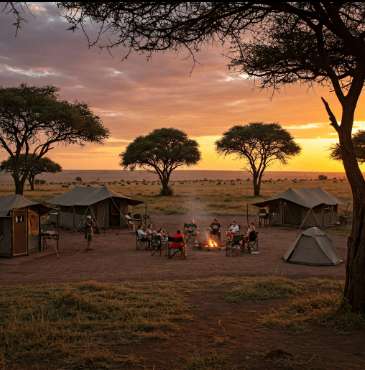
Rather than staying in expensive luxury camps, travelers normally use public campsites or simpler budget accommodation.
You still travel through the same national parks.
You can still see lions, elephants, giraffes, zebras, wildebeest and many other species.
And you can still visit internationally famous destinations such as Serengeti and Ngorongoro.
The main difference is the level of accommodation and exclusivity.
Budget camping normally includes:
Camping keeps you close to nature and can dramatically reduce accommodation costs.
Travelers who do not want to sleep in tents can sometimes combine inexpensive lodges outside national parks with safari drives during the day.
This provides more comfort but normally costs more than public camping.
Another popular strategy is combining both.
For example:
Night 1: Budget lodge near Tarangire
Night 2: Serengeti public campsite
Night 3: Ngorongoro-area lodge
This approach offers a balance between affordability and comfort.
Travelers sometimes assume most of the safari price goes to the tour operator.
In reality, Tanzania safaris contain many unavoidable operational expenses.
Government conservation charges are particularly important. Recent cost analyses note that park and conservation fees can represent a substantial proportion of the total safari price.
Your price may include:
Every traveler entering national parks such as Serengeti or Tarangire must pay applicable conservation fees.
These charges vary according to:
The Ngorongoro Conservation Area has separate charges associated with entering the conservation area, and a vehicle descending into Ngorongoro Crater incurs an additional crater service charge.
Because these official charges can change, your final quotation should always reflect the applicable tariff for your actual travel dates.
A reliable safari requires a capable 4x4.
Typical Tanzania safari vehicles are modified Land Cruisers with:
The vehicle cost is divided among passengers.
This explains why safari groups normally pay substantially less per traveler than solo private travelers.
Imagine a safari vehicle costs the same amount to operate whether there are two passengers or six.
With two travelers, the cost is divided by two.
With six travelers, it is divided by six.
The same principle applies to:
That makes a group-joining safari particularly attractive to:
At Kilipath African Safaris, shared safaris generally operate in safari Land Cruisers with a maximum of around seven travelers, allowing guests to share operating costs while retaining wildlife-viewing access.
Prices change according to dates and availability, but the following examples show how trip length affects the overall budget.
Typical itinerary:
Day 1: Arusha → Tarangire National Park
Day 2: Ngorongoro Crater → Arusha
Approximate budget:
USD 450–650 per person
A two-day safari is ideal for travelers with limited vacation time.
You miss Serengeti, but you can still see tremendous wildlife.
Tarangire is particularly famous for elephants, while Ngorongoro Crater offers one of Tanzania's greatest concentrations of wildlife.
One of the most popular options is:
Day 1: Arusha → Serengeti
Day 2: Serengeti → Ngorongoro area
Day 3: Ngorongoro Crater → Arusha
Approximate planning budget:
USD 600–1,000+ per person
Current market guides commonly quote three-day Serengeti and Ngorongoro camping itineraries in a broad range depending on group arrangements and inclusions.
For travelers whose priority is seeing Serengeti without extending the budget too far, this is one of the most practical itineraries.
A classic itinerary combines three of Northern Tanzania's strongest wildlife destinations.
Leave Arusha in the morning and travel toward Tarangire.
Look for:
Tarangire's enormous baobab trees create one of Tanzania's most recognizable safari landscapes.
Travel through the Ngorongoro highlands toward Serengeti.
Spend the afternoon exploring the plains.
Start early for another game drive.
Possible sightings include:
Later, travel toward Ngorongoro.
Descend into Ngorongoro Crater early in the morning.
Explore the crater floor before returning to Arusha.
Approximate planning cost:
USD 750–1,300+ per person
Group camping normally stays toward the lower end.
Private arrangements normally cost more.
Travelers with five days gain more wildlife-viewing time and a less hurried itinerary.
Possible route:
Day 1: Tarangire
Day 2: Serengeti
Day 3: Serengeti
Day 4: Ngorongoro
Day 5: Lake Manyara → Arusha
Approximate budget:
USD 900–1,600+ per person
The benefit of five days is not simply visiting another destination.
It also allows more time in Serengeti.
And in wildlife tourism, time matters.
You cannot schedule a leopard to appear at 10:00 AM.
More game-drive hours increase your opportunities for exceptional encounters.
A six-day safari can cover the major Northern Circuit highlights comfortably.
Example:
Day 1: Tarangire
Day 2: Serengeti
Day 3: Serengeti
Day 4: Serengeti / Ngorongoro
Day 5: Ngorongoro Crater
Day 6: Lake Manyara
Approximate budget:
USD 1,100–2,000+ per traveler
Travelers considering six or seven days should compare several itinerary designs rather than simply selecting the longest option.
Sometimes an efficiently designed five-day itinerary provides better value than a poorly routed seven-day trip.
Arusha is the principal starting point for Northern Tanzania safaris.
It is strategically positioned for trips to:
Travelers commonly arrive through:
Kilimanjaro International Airport, commonly known as JRO, serves international and regional flights.
Arusha Airport mainly serves domestic connections, including flights from Zanzibar and safari airstrips.
Starting your safari from Arusha is generally the most practical choice for the Northern Circuit.
Not every park contributes equally to transportation costs.
A well-designed itinerary helps reduce unnecessary driving.
Tarangire is relatively accessible from Arusha, making it excellent for shorter budget itineraries.
Highlights include:
Serengeti is usually one of the biggest reasons travelers choose Tanzania.
But reaching it requires additional driving and conservation expenses.
That means adding Serengeti increases your safari cost.
For many travelers, however, it is worth the expense.
The park offers extraordinary year-round wildlife, including:
And during appropriate periods and locations, the wider Serengeti ecosystem hosts different stages of the Great Migration.
Ngorongoro Crater is one of the best destinations for travelers who want a high concentration of wildlife within a relatively compact area.
A typical crater game drive may include:
Black rhinos also live in the ecosystem, although sightings are never guaranteed.
Because the crater descent involves specific vehicle-related conservation costs, group travel is particularly useful for sharing expenses.
Lake Manyara can be included on longer Northern Circuit routes.
The park offers varied scenery, including:
Wildlife can include elephants, giraffes, monkeys, buffalo and numerous bird species.
If your ground-safari budget is approximately USD 1,000 per person, concentrate on a short shared safari.
Strong options include:
3 Days Serengeti + Ngorongoro
Best for travelers whose main priority is Serengeti.
3 Days Tarangire + Ngorongoro + Lake Manyara
Best for reducing driving while visiting three wildlife areas.
4-Day Shared Camping Safari
Possible when group departures and pricing align with your dates.
The most important strategy is keeping expectations realistic.
A USD 1,000 budget should prioritize wildlife rather than private vehicles or luxury accommodation.
With approximately USD 1,500 available, travelers have considerably more flexibility.
You may be able to choose:
For wildlife-focused travelers, investing additional money in an extra safari day is often more valuable than upgrading every night to expensive accommodation.
At roughly USD 2,000 per person, several strong safari combinations become possible depending on dates.
You may consider:
5–7 day group safari
or
Short private budget safari
or
Group safari plus Zanzibar
Your exact options depend heavily on season and group availability.
Choosing accommodation is one of the biggest decisions affecting your safari cost.
| Feature | Budget Camping | Lodge Safari |
|---|---|---|
| Sleeping | Safari tent | Room/permanent tent |
| Bathroom | Usually shared | Usually private |
| Shower | Shared facilities | Usually en-suite |
| Meals | Camp cook | Restaurant/camp dining |
| Price | Lowest | Higher |
| Wildlife | Same parks | Same parks |
| Privacy | Lower | Higher |
| Adventure | High | Moderate |
Camping is not necessarily about sacrificing the safari itself.
You drive through the same parks during the day.
Accommodation mainly changes what happens after you leave the safari vehicle.
Budget camping safaris are routinely operated in Tanzania's safari areas.
However, travelers should always follow campsite and guide instructions.
Wildlife may occur around wilderness camps, which is part of the experience.
Avoid walking away from designated areas after dark.
Never approach animals.
Keep food stored as directed by your safari team.
And ask your guide before leaving your tent at night if local campsite conditions require additional caution.
Public campsite facilities are generally functional rather than luxurious.
Travelers should normally expect:
Travelers who require a guaranteed private bathroom should choose a lodge or permanent tented camp instead.
Always check your quotation carefully.
A properly structured safari package commonly includes:
Exact inclusions should always be written clearly in your confirmed itinerary.
Common exclusions include:
Knowing these costs before departure prevents unpleasant surprises.
This is frequently the biggest money-saving strategy.
Vehicle and guide expenses are divided among travelers.
Public camping is significantly cheaper than premium tented camps.
Accommodation demand and prices can rise during peak safari periods.
If your dates are flexible, ask your operator whether alternative weeks produce better accommodation value.
Bush flights are convenient but increase the trip price.
Road transfers are normally cheaper.
For the Northern Circuit, Arusha is an efficient base.
Every additional destination adds driving time and potentially additional entrance costs.
Choose parks according to your priorities.
Never compare two safari prices using the headline number alone.
Compare:
A cheap-looking safari might exclude something essential.
Best for:
Advantages:
Limitations:
Best for:
Advantages:
The biggest consideration is cost.
A private vehicle is much cheaper per person when four or five travelers divide the cost than when one traveler pays for it alone.
Absolutely—provided you book an appropriately operated safari.
Your accommodation level does not determine whether lions appear.
A traveler in a USD 1,000-per-night camp and a traveler sleeping at a budget campsite may watch exactly the same pride of lions the next morning.
Budget travelers sacrifice amenities.
They do not necessarily sacrifice wildlife.
That is why Tanzania works particularly well for adventurous travelers who care more about the experience than luxury rooms.
Wildlife viewing is possible throughout the year, but season affects:
Travelers whose priority is saving money should avoid choosing dates solely because they are marketed as the single "best" month.
Different seasons can provide excellent wildlife.
Discuss your budget first and then identify the most suitable travel period.
Yes.
A luxury lodge is not required to see migrating wildebeest.
However, migration locations change during the year.
Different months may require travel toward:
Longer routes—especially remote northern migration locations—can increase costs substantially.
Budget group itineraries commonly concentrate on Central Serengeti because it is more practical for standardized departures.
Travelers specifically targeting river crossings or remote migration locations may require a private itinerary.
Many travelers combine safari and Zanzibar.
A common trip looks like:
Day 1–4: Tanzania safari
Day 5: Fly to Zanzibar
Day 6–9: Zanzibar beach holiday
This works particularly well for couples and first-time Tanzania visitors.
However, domestic flights add to the overall budget.
If your main objective is wildlife, allocate your safari budget first and add Zanzibar afterward.
Pack lightly.
Useful items include:
Ngorongoro can be chilly during early morning hours, so a warm layer is especially useful.
A soft-sided bag is generally more convenient inside safari vehicles than an oversized rigid suitcase.
A safari is a complex logistical operation.
Very low prices should prompt questions.
Ask:
Are park fees included?
What accommodation will I use?
How many travelers are in the vehicle?
Is the vehicle suitable for safari?
Are meals included?
Is Ngorongoro Crater included or only the conservation area?
Are transfers included?
Are there additional mandatory payments later?
The goal is not simply finding the cheapest safari.
It is finding the best-value safari that genuinely includes what you expect.
Planning a budget Ngorongoro Crater safari holiday from Arusha? Compare a crater day trip, a two-day Tarangire and Ngorongoro safari, or a…
Read articleA Lake Manyara safari can cost USD 150–220 per person for a shared day trip from Arusha. A published example of a…
Read articleExplore Ruaha National Park’s baobab country on a guided safari built around your dates, group size and budget. Spend your game drives…
Read articleA Nyerere Tanzania wildlife safari can take you from a woodland game drive in the morning to a boat on the Rufiji…
Read article

