

Budget Ngorongoro Crater Safari Holiday
Planning a budget Ngorongoro Crater safari holiday from Arusha? Compare a crater day trip, a two-day Tarangire and Ngorongoro safari, or a…
Read articleArusha City - Tanzania
Safari & Travel Tips
September 3, 2026 · 13 min read
A Nyerere National Park safari Tarangire trip is an excellent choice for travelers who want to experience two very different sides of Tanzania.
Nyerere National Park represents the wild landscapes of Tanzania's Southern Safari Circuit. Here, the mighty Rufiji River creates channels, lakes and floodplains where travelers can experience game drives, boat safaris and guided walking safaris.
Tarangire National Park, on the other hand, belongs to Tanzania's famous Northern Safari Circuit and is particularly celebrated for its elephants, enormous baobab trees and seasonal concentrations of wildlife around the Tarangire River.
Combining these parks means your safari is not limited to one type of landscape or wildlife-viewing experience.
You can spend one morning watching lions and African wild dogs in the wilderness of Nyerere, enjoy a boat safari among hippos and crocodiles in the afternoon, then continue north to discover elephant families walking beneath ancient baobab trees in Tarangire.
According to Tanzania National Parks, Nyerere protects more than 30,000 square kilometers and includes miombo woodland, riverine forest, grasslands, floodplains and the Rufiji River system.
Tarangire covers more than 2,850 square kilometers and is particularly famous for its elephants and baobab-dominated landscapes.
For travelers with enough time, combining these two parks can create one of Tanzania's most varied safari adventures.
Many first-time visitors associate Tanzania primarily with the Serengeti and Ngorongoro Crater.
Those destinations are spectacular, but Tanzania has much more to offer.
Combining Nyerere and Tarangire allows you to experience completely different ecosystems in one holiday.
Together, these parks deliver far more variety than visiting two neighboring reserves with similar environments.
Nyerere National Park lies in southern Tanzania and forms part of the wider ecosystem historically associated with the Selous.
It is one of the country's great wilderness destinations.
The park's defining natural feature is the Rufiji River, which crosses northern Nyerere and creates channels, floodplains and oxbow lakes.
TANAPA describes the park as a landscape of miombo woodland, floodplains, riverine habitat and open grassland.
This habitat diversity helps support a remarkable variety of wildlife.
Unlike some traditional safari parks where game viewing revolves almost entirely around vehicle safaris, Nyerere gives travelers several ways to explore.
The park supports many of Tanzania's most famous species.
Possible sightings include:
Nyerere is particularly important for African wild dogs.
TANAPA describes it as one of East Africa's strongholds for these endangered predators.
Wild dogs are highly mobile, so sightings can never be guaranteed. However, seeing a pack hunting, resting or interacting can become one of the most memorable moments of a Tanzanian safari.
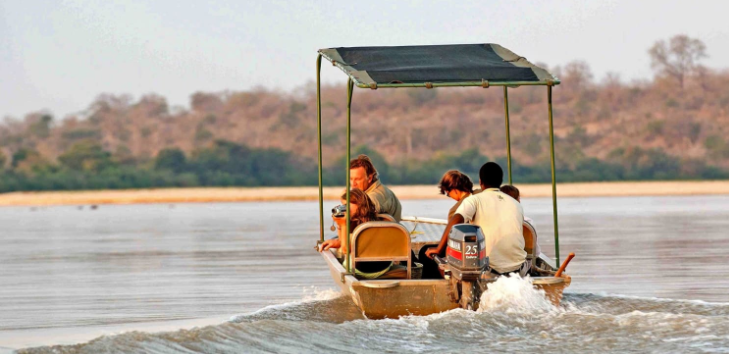
One of the biggest reasons to include Nyerere in your itinerary is its boat safari experience.
Instead of watching wildlife only from a safari vehicle, guests can explore parts of the Rufiji River and its associated lakes by boat.
This completely changes the perspective.
You may encounter:
TANAPA specifically lists boat safaris among Nyerere's signature activities.
An afternoon boat safari can be particularly attractive as temperatures become cooler and the light becomes softer.
For photographers, the combination of wildlife, reflections, river channels and sunset can create excellent opportunities.
Guided walking safaris provide another experience unavailable on many standard safari itineraries.
Rather than concentrating exclusively on large mammals, walking allows travelers to notice smaller details such as:
Walking safaris must be conducted with authorized guides or rangers and appropriate permits.
The objective is not necessarily to walk directly toward large animals. Instead, it is to understand the ecosystem from ground level.
For adventurous travelers, a walking safari can be one of the highlights of Nyerere.
Bird lovers should allow enough time around the Rufiji wetlands.
More than 400 bird species have been recorded in the park, according to Tanzania National Parks.
Possible sightings include:
The combination of wetlands, forests, grasslands and woodland creates excellent habitat diversity.
After exploring Tanzania's south, Tarangire provides a completely different safari atmosphere.
Located southwest of Arusha, Tarangire is one of the main parks on Tanzania's Northern Safari Circuit.
The park is famous for two things above almost everything else:
elephants and baobab trees.
Tanzania National Parks describes Tarangire as the "Paradise of Elephants."
During the dry months, wildlife becomes concentrated around the Tarangire River and other remaining water sources.
This can create exceptional game-viewing conditions.
Elephants are the signature animals of Tarangire.
Visitors regularly encounter family groups containing adults, juveniles and very young calves.
It is common to see elephants:
Watching elephant family behavior can be fascinating.
You may see adults protecting calves, juveniles playing and matriarchs leading their family toward feeding or drinking areas.
During the dry season, Tarangire is especially well known for impressive elephant concentrations.
The second visual symbol of Tarangire is the baobab.
These enormous trees create some of Tanzania's most distinctive safari scenery.
Their thick trunks and dramatic branches make excellent photographic subjects, especially when elephants or giraffes move through the foreground.
Some baobabs are extremely old.
TANAPA notes that some of Tarangire's famous baobabs may be more than 1,000 years old.
For photographers, early morning and late afternoon often provide especially attractive light.
Tarangire is not only about elephants.
Travelers may also encounter:
During the dry season, wildebeest, zebra and other herbivores move toward the Tarangire River as surrounding areas become increasingly dry.
Predators naturally follow these concentrations of prey.
| Feature | Nyerere National Park | Tarangire National Park |
|---|---|---|
| Safari Circuit | Southern Tanzania | Northern Tanzania |
| Signature Landscape | Rufiji River and wilderness | Baobabs and savanna |
| Famous Wildlife | Wild dogs, lions, hippos | Elephants, lions |
| Main Activity | Game drives | Game drives |
| Boat Safari | Excellent | Not the main attraction |
| Walking Safari | Available | Available in designated arrangements |
| Elephant Viewing | Excellent | Exceptional |
| Birdwatching | Excellent | Excellent |
| Best Known For | Rufiji River & wild wilderness | Elephants & baobabs |
| Typical Gateway | Dar es Salaam | Arusha |
The parks complement rather than duplicate one another.
Timing can have a significant influence on wildlife viewing and road conditions.
For travelers primarily focused on wildlife, June through October is one of the strongest periods.
These are generally the drier months.
As surface water becomes less abundant, animals congregate around permanent rivers and water sources.
This benefits both parks.
Wildlife can become concentrated around the Rufiji River, lakes and other water sources.
Road conditions are also generally easier than during heavy rains.
The dry season is particularly famous because large numbers of elephants and plains animals depend on the Tarangire River.
TANAPA specifically highlights dry-season wildlife concentrations around the river.
This can also be an enjoyable period.
The landscapes become greener and birding is excellent.
Young animals may also be present.
There may be occasional rain, but showers often do not prevent safari activities completely.
Travelers who enjoy photography sometimes prefer greener landscapes to the dusty appearance of the late dry season.
These months correspond roughly with Tanzania's long-rain period.
The benefits can include:
However, heavy rain can make some roads difficult.
This is particularly important in remote wilderness destinations.
Some camps may also operate seasonally, so accommodation and transport should be checked carefully before booking.
This is one of the most important planning considerations.
Nyerere belongs to the Southern Circuit while Tarangire belongs to the Northern Circuit.
They are therefore not neighboring parks.
Trying to connect them entirely by road would consume significant safari time.
For most travelers, the more practical strategy is to use domestic flights for at least part of the journey.
Nyerere is commonly reached from Dar es Salaam.
TANAPA notes that visitors can fly from Dar es Salaam to airstrips serving the park, including Mtemere, Siwandu and Beho Beho.
Flying dramatically reduces transit time compared with long-distance road travel.
Tarangire is usually accessed from Arusha.
The drive from Arusha to Tarangire is roughly two hours under normal conditions, although actual travel time varies.
International travelers normally reach northern Tanzania through:
A well-designed itinerary might use flights such as:
Nyerere → Dar es Salaam → Arusha → Tarangire
or another suitable domestic connection depending on airline schedules.
Flight schedules vary by season and day.
Therefore, travelers should not build a rigid itinerary around assumed air connections before confirming current schedules.
A safari operator can coordinate the flights, park transfers and lodge arrangements into one itinerary.
One possible itinerary is:
Arrive in Tanzania and transfer to your hotel.
Use the evening to rest before beginning your safari.
Take a domestic flight into Nyerere.
After arrival, meet your safari guide and transfer to camp or lodge.
Depending on your arrival time, you may have an afternoon activity.
A sunset boat safari can make an excellent introduction.
Overnight: Nyerere National Park
Start early in the morning.
Search for:
Your guide will select routes based on current wildlife movement and conditions.
Lunch may be served at your lodge/camp or enjoyed as a picnic during the game drive.
Continue exploring during the afternoon.
Overnight: Nyerere National Park
Begin with a guided nature walk where available.
Learn about:
Return for breakfast and relaxation.
Later, enjoy a boat safari along the Rufiji River system.
Watch for hippos, crocodiles, elephants and waterbirds.
Overnight: Nyerere National Park
Leave Nyerere after breakfast and connect by air toward northern Tanzania.
Arrive in Arusha and transfer to your hotel.
This transition day makes the itinerary more comfortable rather than attempting to combine long flights and a full safari drive.
Overnight: Arusha
Depart Arusha in the morning and drive toward Tarangire.
Enter the park and begin your game drive.
Watch for:
Enjoy a picnic lunch inside the park before continuing your afternoon drive.
Overnight: Tarangire or nearby lodge
Start your final safari early.
Morning temperatures are comfortable and wildlife may be particularly active.
Explore another area of Tarangire before returning toward Arusha.
Your trip can then finish in Arusha or connect with another destination.
If budget and holiday time allow, 8 to 10 days is even better.
A longer itinerary provides:
Travelers could extend the northern portion to include:
Tarangire → Ngorongoro Crater → Serengeti
This creates a very comprehensive Tanzania safari.
Both destinations provide several levels of accommodation.
Budget-oriented travelers may use simpler camps or lodges where available.
Expect fewer luxury features but the same access to wildlife destinations.
Mid-range tented camps are popular because they balance comfort and safari atmosphere.
Typical facilities may include:
This category is often ideal for couples and families seeking comfort without the cost of top-end luxury camps.
Luxury camps can provide a highly personalized experience.
Depending on the property, features may include:
Luxury fly-in safaris work particularly well when combining distant parks such as Nyerere and Tarangire.
There is no single fixed price.
The final cost depends on:
A private safari for two people normally costs more per person than the same itinerary shared between four or six travelers because vehicle and guide costs are divided among fewer guests.
Domestic flights can also contribute significantly to the price when combining northern and southern Tanzania.
For this itinerary, a custom quotation is generally more accurate than publishing one permanent safari price.
A professionally organized package may include:
Always read your quotation carefully.
Possible exclusions include:
Your operator should clearly identify these before payment.
Because Nyerere and Tarangire are far apart, this itinerary works particularly well as a private safari.
Private arrangements provide:
Shared tours can be cheaper but may operate on fixed itineraries.
Travelers specifically wishing to combine Southern and Northern Circuit parks should confirm whether shared departures are available.
A sensible safari packing list includes:
TANAPA recommends neutral clothing, sun protection and binoculars when visiting Nyerere and Tarangire.
A Nyerere Tarangire combination is especially attractive for photography.
Look for:
Focus on:
A telephoto lens is useful for wildlife, while a wider lens can capture animals within dramatic landscapes.
Yes.
Families can especially enjoy:
However, minimum-age restrictions can apply to activities such as walking safaris.
Families traveling with young children should confirm these restrictions before booking.
Very much so.
The itinerary has a particularly adventurous and romantic character because it combines:
A private safari can be adapted for honeymoon travelers with special accommodation or romantic arrangements where available.
Safari parks are wild environments.
Travelers should always follow guide instructions.
Important rules include:
TANAPA specifically advises maintaining generous distances from large animals such as elephants and buffalo.
A Nyerere National Park safari Tarangire trip showcases Tanzania's extraordinary ecological variety.
Nyerere introduces travelers to the waterways and remote wilderness of southern Tanzania, where boat trips along the Rufiji River complement traditional game drives and walking safaris.
Tarangire provides a completely different scene: giant baobab trees, open savanna, the Tarangire River and remarkable elephant gatherings.
Combining them requires more logistical planning than visiting neighboring parks, but the reward is a safari filled with dramatically different landscapes and wildlife encounters.
For travelers with approximately seven to ten days, a private itinerary combining Nyerere National Park, Arusha and Tarangire National Park can provide an outstanding Tanzania safari experience.
Planning a budget Ngorongoro Crater safari holiday from Arusha? Compare a crater day trip, a two-day Tarangire and Ngorongoro safari, or a…
Read articleA Lake Manyara safari can cost USD 150–220 per person for a shared day trip from Arusha. A published example of a…
Read articleA Tanzania safari from Zanzibar can mean a short mainland trip during your beach holiday or a complete package with flights, game…
Read articleLooking for a group Tanzania safari price from Kilipath African Safaris? A published example for our four-day shared camping safari through Tarangire,…
Read article

